Contrast Therapy: Definition, Evidence, and Protocols
What the term actually means, what happens physiologically, how strong the research is claim by claim, and the hot-to-cold ratios and temperatures that appear in the published literature rather than in marketing copy.
Contrast therapy means alternating heat and cold in one session, either as contrast water therapy (warm bath at 38-40°C, cold bath at 10-15°C) or as sauna plus cold plunge. Typical published protocols run 3:1 or 1:1 hot to cold, 20-30 minutes total. The honest summary of the evidence: it clearly beats passive rest for soreness and strength loss (Bieuzen et al., 2013), it has not been shown to beat cold water immersion alone (Higgins et al., 2017), and the vascular pump mechanism everyone repeats has only weak support in humans (Breger Stanton et al., 2009).
What contrast therapy is
Contrast therapy is the deliberate alternation of heat and cold exposure inside a single session. That is the whole definition. Everything else, including ratios, temperatures and cycle counts, is implementation detail that varies by tradition and by study.
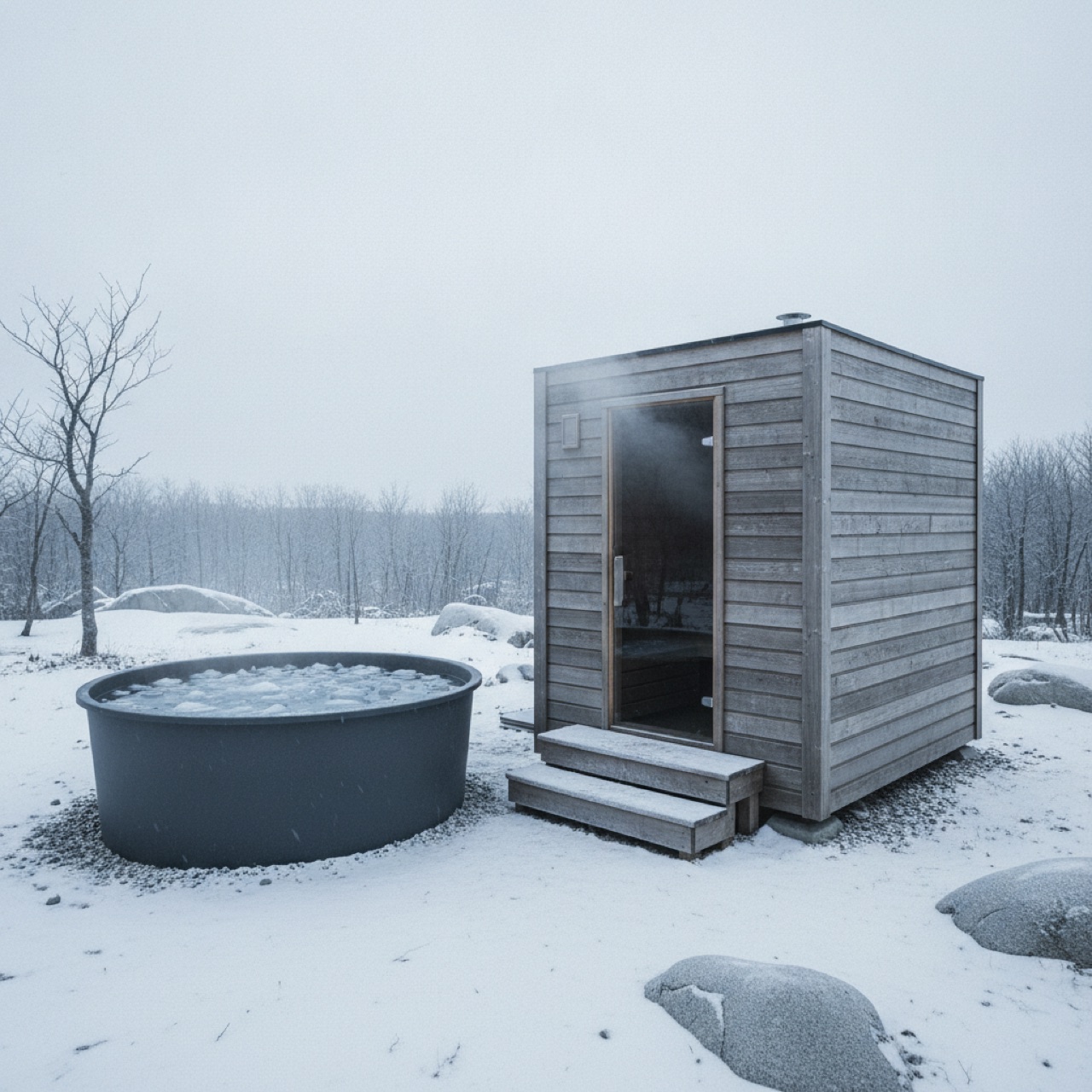
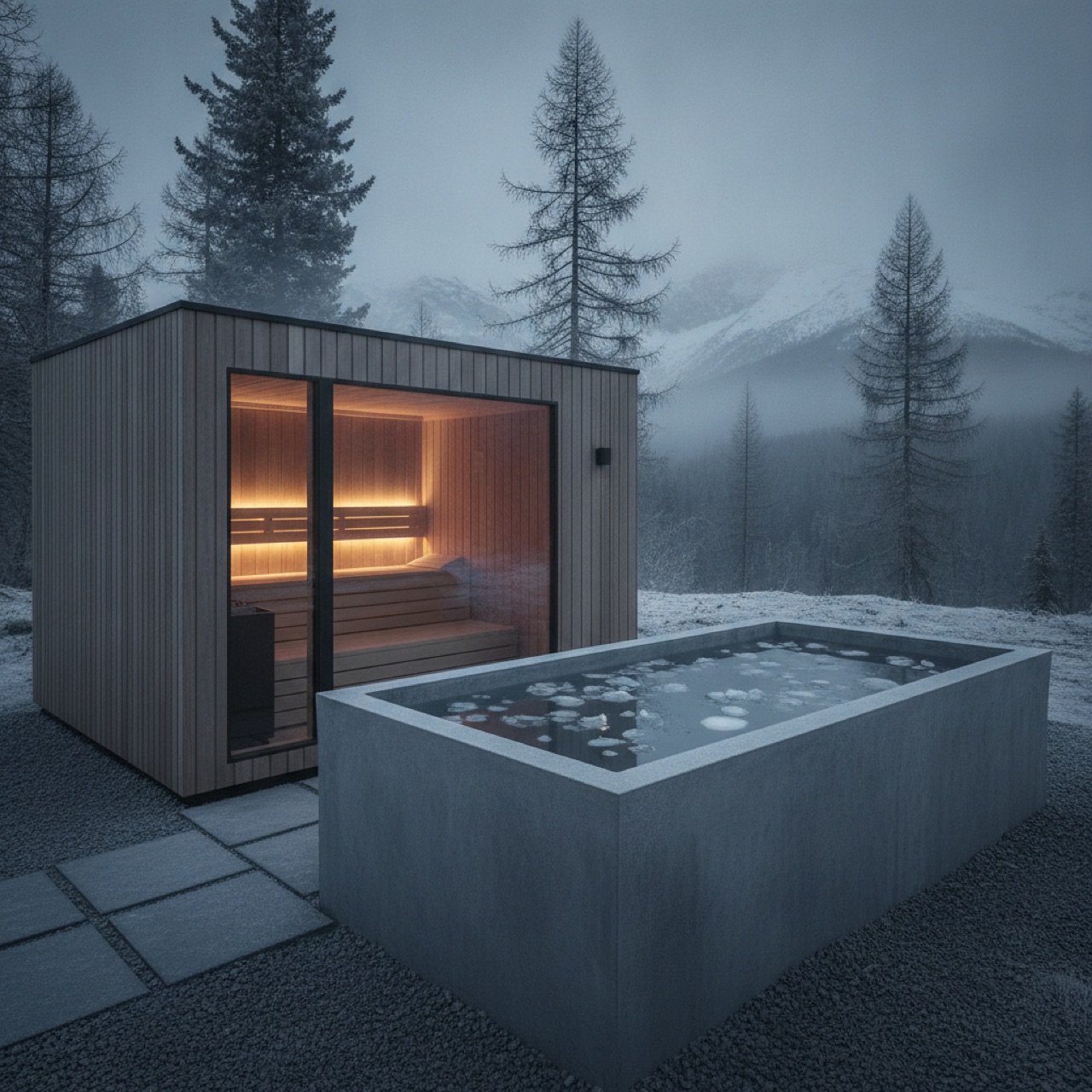
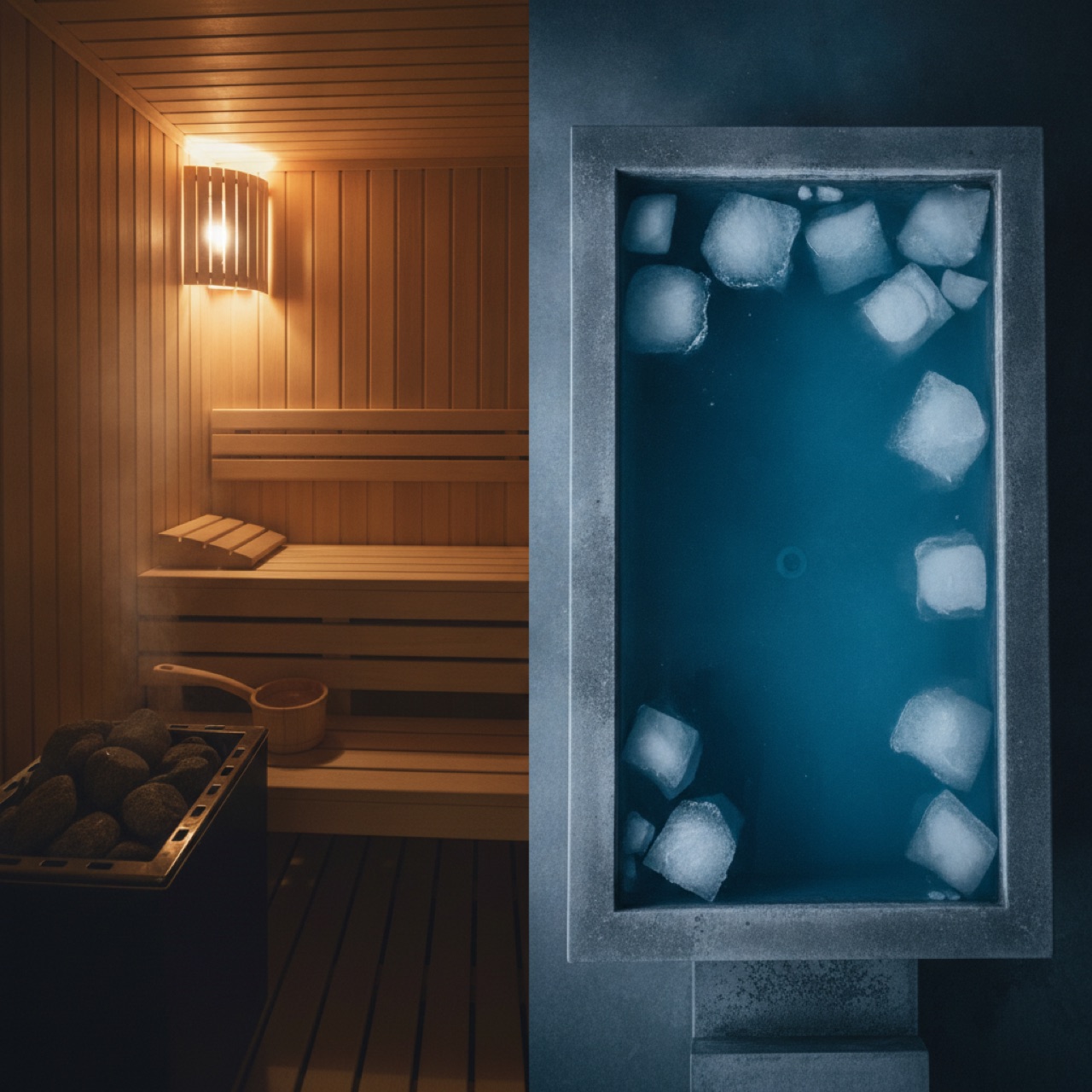
Two formats carry the name. Contrast water therapy, also called contrast bath therapy, alternates immersion in warm water with immersion in cold water. This is the version used in physiotherapy clinics, in athletic training rooms and in essentially all of the controlled research. Sauna and cold plunge substitutes a hot room at 80-100°C for the warm bath, and it is the version most consumers mean when they buy equipment.
The distinction is not pedantic. Bieuzen, Bleakley and Costello (2013) reported a pooled warm-phase temperature of 39.3°C across the trials they analysed. A Finnish sauna runs at roughly double that number in air, delivers a far larger cardiovascular load, and produces heat shock protein and growth hormone responses that a 39°C bath does not. When a marketing page cites contrast bath research to sell a sauna, it is quietly swapping one intervention for another. Our cold plunge versus sauna comparison covers where the two modalities genuinely differ.
The vascular pump claim, examined honestly
The standard explanation goes like this. Heat causes vasodilation, cold causes vasoconstriction, alternating the two makes vessels open and close rhythmically, and that rhythm acts as a pump that pushes fresh blood into tissue and flushes metabolic waste out. It is a satisfying mental picture, it appears on almost every product page, and the human evidence for it is thin.
What is solidly established is the surface response. Skin blood flow and skin temperature swing measurably with each phase, and limb arterial flow rises sharply during warm immersion before dropping below baseline during cold immersion. A 2024 single-arm interventional study using near-infrared spectroscopy also recorded increased oxygenated blood volume in fatigued lower-leg muscle during alternating local heat and cold, alongside shifts in autonomic activity.
What has not been established is the step that matters clinically. Breger Stanton, Lazaro and MacDermid (2009, Journal of Hand Therapy) screened contrast bath studies back to 1938, included 10, and concluded only that there was weak evidence for improvement in superficial blood flow and skin temperature, with the available evidence too limited for definitive conclusions. Intramuscular temperature change during contrast baths is modest. No study has shown that the alternation clears metabolic byproducts faster than warm immersion or than simply resting.
Treat it as a plausible hypothesis with partial support at the skin, not as an established mechanism in muscle. If contrast therapy helps you, the more defensible explanations are the well-documented effects of the cold phase itself plus a genuine analgesic and perceptual benefit, not a circulatory flush that has never been measured where it is claimed to happen.
What the evidence shows, claim by claim
Contrast therapy is not pseudoscience and it is not a breakthrough. It sits in the middle of the recovery evidence base: better than nothing, roughly equal to its competitors, and studied with protocols too varied to produce a single recommendation. Below, each popular claim is graded against the review-level literature.
Bieuzen, Bleakley and Costello (2013, PLoS ONE) pooled 13 of 18 controlled trials and found significantly better muscle soreness and reduced strength loss at under 6, 24, 48, 72 and 96 hours versus passive recovery. The authors flagged that every included trial carried a high risk of bias, and that effect magnitudes may be most relevant to elite athletes.
Bieuzen et al. compared contrast water therapy against cold water immersion, warm water immersion, compression, active recovery and stretching, and found little evidence for a superior intervention. Higgins, Greene and Baker (2017, Journal of Strength and Conditioning Research, 31(5):1443-1460) went further in team-sport athletes: contrast water therapy helped only perceived fatigue at 48 hours, while cold water immersion produced the neuromuscular benefit at 24 hours.
Breger Stanton, Lazaro and MacDermid (2009, Journal of Hand Therapy, 22(1):57-70) screened 28 papers back to 1938, included 10, and reported only weak evidence for improvement in superficial blood flow and skin temperature, with no definitive conclusions available. Surface effects are measurable. A deep-tissue flushing effect has not been demonstrated in humans.
A 2025 scoping review in the Journal of Clinical Medicine covering 7 studies and 303 patients across exercise-induced muscle damage, ankle sprain, osteoarthritis and complex regional pain syndrome reported improvement in initial clinical condition across studies, while stating that protocol heterogeneity and modest trial quality prevent conclusions about effectiveness relative to other therapies.
No head-to-head trial programme has isolated ratio as a variable at sufficient scale. The 3:1 convention traces to clinical habit, not to a comparative study that beat 1:1. Reviews consistently name protocol heterogeneity as the reason a recommendation cannot be issued.
This is a practice convention with a plausible rationale (sympathetic activation, endogenous rewarming) and no comparative trial behind it. The one context where the ending demonstrably matters is sleep timing, because a cold finish elevates alertness for hours.
One more framing point. Hohenauer and colleagues (2015, PLoS ONE) pooled 27 post-exercise cooling studies and found cold water immersion reduced delayed onset muscle soreness at 24 hours with a standardised mean difference of -0.75, an effect that persisted at 48 and 96 hours. Cold on its own has a reasonably clean effect signal. Adding heat blocks around it has never been shown to improve on that. If you want the practical version of this for training, see our cold plunge recovery guide.
Protocols and ratios actually used
Ratios are quoted as hot minutes to cold minutes. The 3:1 convention comes from rehabilitation practice, the 1:1 from sports recovery trials, and neither has beaten the other in a comparative study. Total session time in published work clusters between 6 and 30 minutes.
The practical reading of that table: pick a ratio, keep temperatures inside the researched bands, and hold the protocol constant long enough to judge it. A 2025 scoping review in the Journal of Clinical Medicine, covering 7 studies and 303 patients, named protocol heterogeneity as the specific reason no clinical guideline can be written for contrast therapy. Chasing an optimal ratio is chasing a number that does not exist yet.
Temperature discipline matters more than ratio. Bieuzen et al. pooled a cold-phase mean of 11.1°C with a range of 8-15°C, which is warmer than much popular advice suggests. If you are choosing a set point for a plunge tub, our cold plunge temperature guide works through the trade-offs.
Contrast baths versus sauna and plunge
Contrast baths are localised, low-stress and easy to standardise. A limb goes into 39°C water, then into 11°C water, and the cardiovascular load stays modest. The sauna and cold plunge format is whole-body, produces heart rates well above 100 BPM in the heat phase, and applies a much larger swing across the transition. Same category name, different physiological event.
That means the sauna format inherits the research support of contrast baths only loosely. It has its own separate evidence base, largely epidemiological for the sauna side, and its own separate risk profile. If you are running the sauna version, the practical build is covered in our sauna cold plunge routine guide, the sequencing question in sauna or cold plunge first, and the lower-cost hardware route in the hot tub and cold plunge combo guide. A hot tub at 38-40°C is, notably, closer to the researched warm phase than a sauna is.
The end on cold rule and its weak base
Almost every popular protocol instructs you to finish cold. The stated rationales are that a cold finish leaves vessels constricted and reduces post-session swelling, and that endogenous rewarming rather than external heat drives metabolic adaptation. Both are reasonable. Neither has been isolated in a trial comparing a cold-finish protocol against an otherwise identical hot-finish protocol.
Where the ending demonstrably matters is timing relative to sleep. A cold finish elevates sympathetic tone and alertness for hours, which is useful in the morning and actively unhelpful at 9pm. A heat finish raises core temperature, which then falls, and that decline resembles the thermal drop that accompanies sleep onset. Choose the ending by the clock rather than by the convention, and be sceptical of anyone presenting the cold finish as settled science.
Safety and who should avoid it
The risk in contrast therapy is concentrated in the transition, not in either temperature on its own. Moving from heat into cold takes a maximally vasodilated cardiovascular system and constricts it within seconds, spiking blood pressure while heart rate is still elevated. Shattock and Tipton (2012, Journal of Physiology) described the additional problem of autonomic conflict: cold immersion simultaneously triggers a sympathetic cold shock tachycardia and a parasympathetic diving bradycardia, and the collision of the two can generate arrhythmias in healthy volunteers, which in vulnerable individuals may be lethal.
Alcohol turns a manageable risk into a documented one. Kenttämies and Karkola (2008, Journal of Forensic Sciences) reviewed sauna deaths in Finland from 1990 to 2002 and found alcohol involved in roughly half of all cases, with heat exposure the direct cause of death in a quarter of them. Their prevention advice was blunt: drink less, and do not leave an intoxicated bather alone. The same logic applies to any hot-cold session.
- -Uncontrolled hypertension
- -Recent myocardial infarction or unstable angina
- -Known cardiac arrhythmia
- -Peripheral vascular disease or advanced diabetes with neuropathy
- -Epilepsy
- -Cold urticaria or Raynaud phenomenon
- -Pregnancy (sauna format in particular)
- -Open wounds or acute infection
- +No alcohol before or during a session, none
- +Enter cold water slowly and never hold your breath
- +Start at 13-15°C and let the cold shock response habituate over weeks
- +Keep the first cold blocks to 30-60 seconds
- +Do not practise alone while you are still adapting
- +Rehydrate: the heat phase costs fluid you will not feel losing
- +Exit immediately on chest pain, dizziness or confusion
One training-specific caution that is not a safety issue but is a goal-conflict issue: Roberts et al. (2015, Journal of Physiology) showed that cold water immersion after resistance training attenuates the anabolic signalling that drives hypertrophy. If a session is built around muscle growth, keep the cold phase away from it by a day.