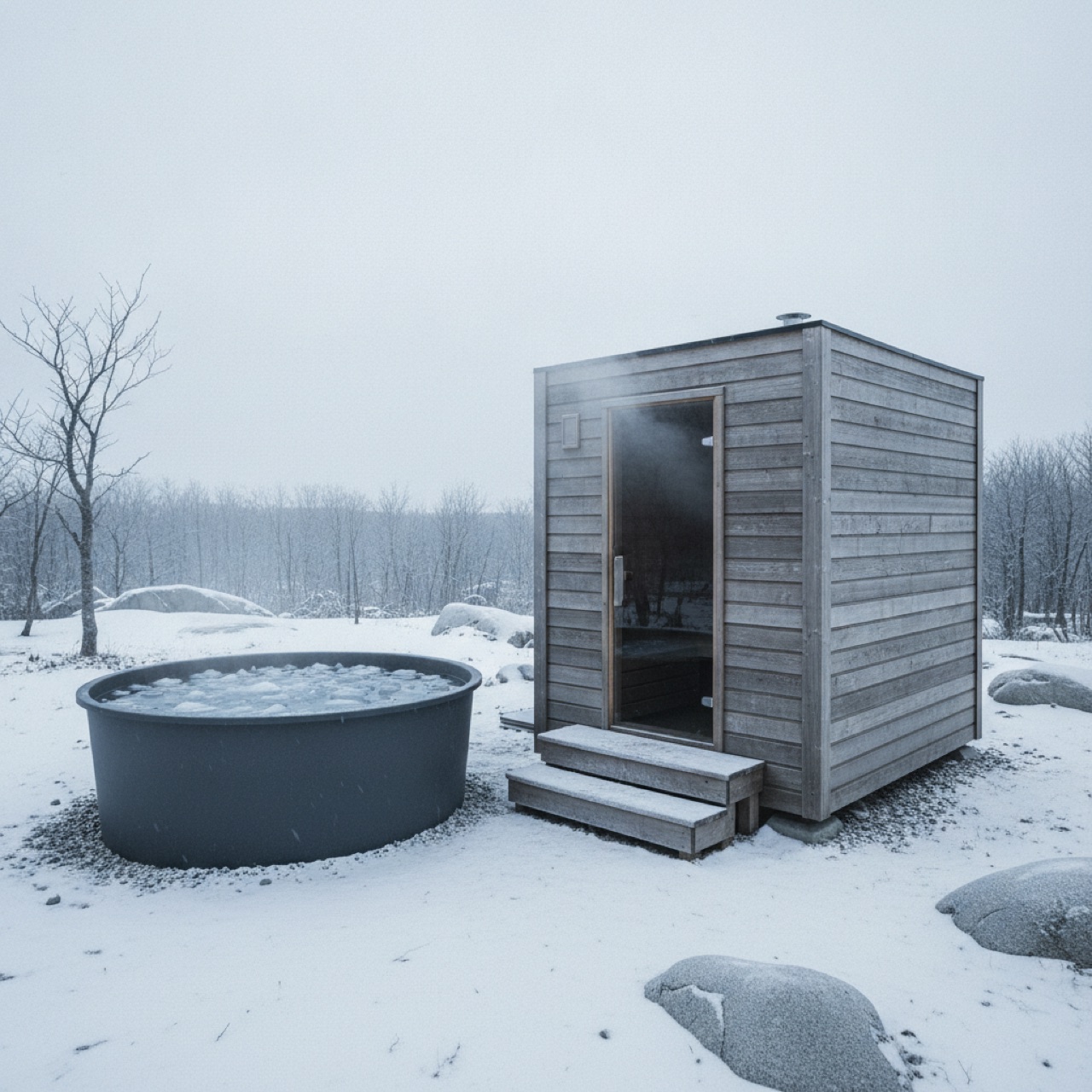
Sauna or Cold Plunge First? The Physiology-Based Answer
Sauna first is the correct default for most people and most goals. But no RCT has tested this directly, and there are specific cases where reversing the order is the right choice. Here is the full picture -- including the growth hormone caveat most guides omit.
Sauna first is the correct default for most people. Heat vasodilates vessels; cold then produces a larger vascular contraction from that dilated baseline. For most goals -- recovery, alertness, cardiovascular adaptation -- end cold. Two exceptions: if growth hormone is your goal, do cold first or skip cold (cold after sauna blunts GH). If you are doing this close to bedtime, end on sauna not cold -- the norepinephrine from cold can delay sleep by 1-2 hours.
The honest caveat: what the evidence actually shows
The sauna-first recommendation is widely stated in contrast therapy guidance. What is less frequently stated: no rigorous randomized controlled trial has compared sauna-first versus cold-first as the primary variable with sufficient power to distinguish the outcomes. The consensus is built on two things -- physiological reasoning (which is coherent) and the fact that Finnish tradition and most contrast therapy research happen to use the sauna-first order.
That does not make the recommendation wrong. The physiological argument for sauna-first is sound. But it means the claim that sauna-first is demonstrably superior rests on mechanism, not a head-to-head trial. This is worth knowing, because it means individual variation is plausible -- some people may genuinely respond better to cold-first -- and it means the priority should be consistency and appropriate dose, not anxiety about which phase to start with.
- +Contrast therapy (combined heat + cold) outperforms either alone for tissue hyperemia (2024 RCT)
- +Finnish sauna practice (sauna-first format) has strong epidemiological cardiovascular evidence
- +Cold immersion after resistance training blunts mTOR/hypertrophy (Roberts 2015)
- +Finishing cold preserves brown fat thermogenic response (Soberg 2021)
- -Head-to-head comparison of sauna-first vs. cold-first as primary variable
- -Optimal transition time between sauna and cold plunge
- -Whether protocol order differences generalise across sexes (most research is male)
- -Dose-response relationship for order effects on specific hormonal outcomes
What the sauna-first sequence does physiologically
Entering a sauna at 80-100°C initiates a cascade of cardiovascular changes. Skin blood flow increases substantially. Heart rate climbs to 100-150+ BPM as the body attempts to dissipate heat. Blood vessels in the periphery dilate to maximum capacity. Core temperature rises toward 38.5-39°C over a 15-20 minute session.
When you then enter cold water, you are transitioning from maximal vasodilation to cold-induced vasoconstriction. The vascular swing -- from dilated to constricted -- is substantially larger than if you had entered cold from a resting body temperature. This larger swing is the core mechanism behind the cardiovascular training effect of contrast therapy specifically, as opposed to cold plunging alone.
Additionally, the body is already warm when cold is applied. This is not just comfortable -- it is physiologically relevant. The cold shock response (the involuntary gasp and tachycardia triggered by cold water on skin) is less acute when core temperature is elevated. You are adapting to the cold from a warmer baseline, which reduces the severity of the shock response.
What the cold-first sequence does differently
Cold plunging first -- from a resting body temperature -- produces the most physiologically stressful moment in the contrast therapy sequence. The cold shock response is at its most intense: the body has not been pre-warmed, vessels are at resting diameter (not dilated), and the transition to cold is acute. Heart rate typically spikes sharply within the first 15-30 seconds.
After the cold phase, the sauna then vasodilates vessels that were constricted -- a different kind of vascular swing. Blood flow returns to the periphery. The body rewarms. This is a valid physiological stimulus, but the sequence of vasoconstriction-then-dilation is generally considered a weaker cardiovascular training signal than the reverse. The warmth of the sauna also provides a rescue from the cold shock that modifies the norepinephrine response.
One practical consequence of cold-first: the calm, focused state that follows cold immersion (often described as a clear-headed alertness) may actually enhance the sauna experience for some people. Some practitioners specifically prefer cold-first for this reason -- they find the sauna more contemplative and enjoyable when entered after cold.
- +Larger vascular swing (dilated to constricted)
- +Cold shock is less severe (body pre-warmed)
- +GH response from sauna is blunted by cold
- +NE surge happens at session end -- lasts into afternoon
- +Standard format of Finnish tradition and most research
- +Highest acute physiological stress of the session
- +Cold shock at resting body temperature -- more intense
- +GH response from subsequent sauna preserved
- +NE surge happens early; calm focus for sauna session
- +Less acute BP spike for hypertensive individuals
Goal-by-goal: which order to use
The correct sequence depends on what you are trying to accomplish. The table below shows the recommended order, timing, and rationale for each goal:
The growth hormone caveat: why it matters
Heat exposure in a Finnish-temperature sauna (80-100°C) stimulates a meaningful growth hormone surge. This is one of the better-characterized hormonal responses to sauna use and is part of why sauna has long been used by athletes in recovery phases. The GH response is not enormous in absolute terms compared to the GH released during sleep, but it is real and accumulates with regular practice.
The complication: cold immersion immediately following the sauna appears to blunt this GH response. The mechanism is not perfectly characterized in the published literature, but the interaction has been discussed specifically by Huberman and is consistent with what we know about the hormonal cascade involved. The cold transition may interrupt the GH signal before it fully expresses.
For most people doing contrast therapy for recovery, mood, or cardiovascular adaptation, this is not a meaningful tradeoff. The NE response from cold, the cardiovascular training effect of the vascular swing, and the recovery benefits of the combined protocol are more relevant to their goals than GH optimization.
But for athletes specifically targeting GH for recovery or body composition reasons, this is worth structuring around. The practical solutions are: (1) do cold first on days you want GH elevation, then sauna; (2) skip cold entirely on those sessions; (3) do cold and sauna on separate days. There is no need to choose one approach permanently -- you can use sauna-first on most sessions and reverse on sessions where GH is the priority.
Order and sleep: why ending on cold can be a mistake at night
The standard recommendation -- finish cold -- is correct for most situations. In the evening close to bedtime, it can work against you.
Cold immersion produces a norepinephrine surge that can persist for 2-4 hours. If you finish a cold plunge at 9pm, you may be experiencing elevated sympathetic tone until 11pm or midnight. For people who struggle with sleep onset, this is a meaningful disruption. The problem is not the contrast therapy session itself -- it is ending with the stimulus that produces the most activating hormonal response.
If an evening session is your only practical option and sleep quality matters to you, consider ending on sauna instead of cold. The heat raises core body temperature, which then falls naturally after leaving the sauna. This temperature decline mimics the thermal drop that accompanies sleep onset and can actually accelerate sleep latency rather than delay it. If you still want a cold component, keep it brief (60-90 seconds) and allow at least 90 minutes between the session and bedtime.
What experts and Finnish tradition actually recommend
Huberman's standard protocol is sauna-first, finish cold, 3 rounds. He is specific about the GH caveat: if growth hormone elevation is the session goal, reverse the order or skip cold entirely. For alertness, mood, and metabolic benefits, he recommends the standard sauna-first order.
Patrick emphasizes the metabolic benefits of ending cold (thermogenic brown fat activation) for most sessions. She has also noted that ending on a gentle heat phase can be appropriate for recovery and relaxation contexts, particularly when sleep is the goal. She generally follows the sauna-first structure.
Traditional Finnish practice does not contemplate cold-first. The structure is sauna (10-20 min at 80-100°C), cold immersion (lake, river, or snow -- no specific temperature target), rest (15-20 min). Repeated 2-4 times. The rest phase is essential, not optional. The session ends with rest or gentle cooling, not a final sauna round. Finnish practice is the most time-tested and epidemiologically supported contrast therapy format available.
Safety note: cold-first carries the highest acute risk
If you are considering cold-first sequencing, this matters: cold shock risk is highest when cold is applied suddenly to a body at resting temperature. The involuntary gasping, tachycardia, and blood pressure spike of the cold shock response are most severe in this scenario -- more severe than when the body has been pre-warmed by sauna.
For most healthy, acclimated practitioners, this is manageable. For people with underlying cardiovascular conditions -- hypertension, arrhythmia, recent cardiac events -- cold-first from a resting temperature is genuinely higher risk than sauna-first. This is not a reason to avoid cold-first categorically, but it is a reason to acclimate gradually and to discuss the approach with a physician if any cardiac history is present.
Absolute contraindications for any contrast therapy (in any order): uncontrolled hypertension, recent myocardial infarction, unstable angina, cardiac arrhythmia, epilepsy, pregnancy, cold urticaria, Raynaud's disease.
142 days in real cold
Every unit ran in a controlled 8°C ambient room and an unheated garage in Trondheim. We logged temperature stability, recovery rate, noise, and energy draw on calibrated probes.