Cold Plunge Heart Rate & Blood Pressure:
what it does to your heart, and who should be careful.
A cold plunge sends your heart rate and blood pressure up sharply in the first 30 seconds, then both settle over about two minutes as your breathing comes under control. For a healthy heart this brief spike is well tolerated, much like a sprint. The real concern is people with heart disease, uncontrolled high blood pressure, arrhythmia, a recent cardiac event, or a channelopathy, who should get medical clearance first. A specific hazard called autonomic conflict, where the cold shock response and the diving reflex fire at once, can trigger irregular rhythms, so never plunge face-first or breath-hold underwater. Over time, regular cold exposure is linked to better heart rate variability, but that is a long-term association, not a reason to ignore the acute risks.
This article is educational and is not medical advice. It cannot tell you whether your heart can safely handle cold water. If you have any cardiovascular condition, high blood pressure, an arrhythmia, a pacemaker or implanted device, or take heart or blood pressure medication, talk to your doctor before cold plunging. If you feel chest pain, an irregular heartbeat, or faintness during a plunge, get out and seek medical help.
What a cold plunge does to your heart rate
The moment cold water hits your skin, cold receptors fire a sympathetic nervous system alarm. Heart rate climbs fast, and it climbs within seconds, not minutes. This is part of the cold shock response, the involuntary reaction to sudden immersion that also drives the gasp and the fast, hard breathing you feel on entry. In physiological terms there is a simultaneous surge in heart rate, blood pressure, and cardiac output, all peaking early. The reaction is generally at its strongest around the first 30 seconds, and control of breathing typically returns over roughly two minutes.
How high your heart rate goes depends on several things: how cold the water is, how much of your body goes under, your fitness and resting heart rate, and how well you manage your breathing. There is no single "normal" number, because a fit person easing into 55°F (13°C) water and a beginner dropping into near-freezing water are having very different experiences. What is consistent is the shape of the response: a quick spike, then a settling. A fast heart rate on entry is expected and not, by itself, a warning sign. What you are managing is not the speed of the beat but the panic-like breathing that comes with it, which is exactly what our guide to cold plunge breathing is built around.
The practical point: the first half minute is where the cardiovascular demand is highest, so it is the window where technique matters most. Enter gradually rather than jumping in, keep your head above the surface, and let the surge pass before you decide anything. Trying to "tough out" the shock by going fully under makes the demand worse at the exact moment your body is least in control.
Cold plunge and blood pressure
Here is where cold immersion does something unusual. Normally, when your blood pressure rises, a reflex slows your heart to compensate. In cold water, both go up together. The cold clamps down peripheral blood vessels hard (vasoconstriction), which drives blood pressure up, while the cold shock response drives heart rate up at the same time. The result is a sharp, transient rise in blood pressure layered on top of a racing heart.
The magnitude can be striking. In one frequently cited measurement of ice-water exposure, mean blood pressure rose from about 130/76 mmHg at rest to 175/93 mmHg after one minute. For a healthy vascular system this passes without harm. For someone with poorly controlled hypertension or fragile arteries, an abrupt spike of that size is exactly the kind of stress that raises the risk of a cardiac or cerebrovascular event. This is the core reason blood pressure history matters before you start.
There is a second, opposite hazard on the way out. When you climb out and rewarm, the clamped vessels dilate again, and blood pressure can fall, sometimes below where it started. If you stand up quickly, blood flow to the brain drops and you feel lightheaded or even faint. That is why the exit is one of the two genuinely risky moments of a plunge, and why you should stand slowly and rewarm gradually. We cover the exit and rewarming in more detail in our full cold plunge side effects guide.
Autonomic conflict and arrhythmia risk
The most important cardiac concept in cold water is the one fewest people have heard of. Your autonomic nervous system has two opposing branches: the sympathetic (accelerator) and the parasympathetic (brake). Cold water immersion can stamp on both at the same time. The cold shock response is a sympathetic surge that speeds the heart up. But if you submerge your face or hold your breath, you also trigger the diving response, a parasympathetic reaction that slows the heart down. Two branches, opposite commands, at once.
Professor Mike Tipton of the University of Portsmouth, one of the leading researchers in cold water physiology, and his colleague Michael Shattock described this in a 2012 paper in the Journal of Physiology with a deliberately blunt title: "Autonomic conflict: a different way to die during cold water immersion?" Their argument is that the simultaneous activation of both branches can provoke cardiac arrhythmias, and that in some vulnerable people this may be the true cause of deaths that get recorded as drowning or hypothermia. It reframes cold water risk: it is not always about slowly freezing, it can be about the heart's rhythm destabilizing in the first moments.
Honesty about the evidence grade matters here. The autonomic conflict model is well argued and physiologically plausible, and it fits real-world drowning patterns, but it is not fully settled. Later experimental work, including a healthy-animal-heart model, did not reproduce dangerous arrhythmias in the absence of pre-existing heart disease, which suggests a structurally normal heart has real tolerance for this stress. The reasonable reading is this: in a healthy heart, brief arrhythmias during cold immersion are usually benign and self-limiting, but the risk is meaningfully higher when heart disease is already present, and the behaviors that stack the two responses are avoidable. So the takeaway is simple and free: do not plunge face-first, and do not breath-hold underwater during the first minute.
Is cold plunging safe for your heart?
For most healthy adults, a short, controlled plunge is generally safe for the heart. The spike in rate and pressure is real but brief, and a structurally normal heart absorbs it the way it absorbs a hard set of stairs or a sprint. That is the honest baseline, and it is why millions of people plunge without incident.
But the risk is not spread evenly across people. The American Heart Association has publicly cautioned that the cold shock response can be dangerous for those with pre-existing heart conditions, and has noted that little of the research on cold water immersion has actually studied people with heart disease. That is a candid admission worth respecting: the reassuring safety data mostly comes from healthy volunteers, so it does not automatically transfer to a heart that already has a problem. If you have a cardiac history, the sensible default is caution and a conversation with your doctor, not extrapolation from studies that did not include you.
Who needs medical clearance first
The following should treat cold plunging as something to clear with a physician before starting, or to avoid. If you are in one of these groups, the general "it is usually safe" framing does not apply to you.
- Coronary artery disease or any diagnosed heart disease
- Uncontrolled or poorly controlled high blood pressure
- A history of arrhythmia, including atrial fibrillation
- A recent heart attack, cardiac surgery, or a stent
- A known long QT syndrome or other channelopathy
- A pacemaker, implanted defibrillator, or a history of fainting
Medications change the picture too. Beta-blockers blunt the heart rate response, which can mask the warning signs your body would normally give. Some blood pressure drugs, diuretics, and sedatives alter how you manage blood pressure and temperature, and can make it harder for your body to adapt to the shock. If you take a daily cardiovascular or psychiatric medication, raise cold plunging with your prescriber rather than assuming it is fine. The same caution applies if you are unwell: being sick already stresses the cardiovascular system, which is one reason we advise skipping sessions when run down in our guide to cold plunging when sick.
Heart rate variability over time
So far this has been about the acute spike. The longer-term story is more encouraging, and it centers on heart rate variability (HRV), the small beat-to-beat variation in your heart rhythm. Higher HRV generally reflects strong parasympathetic (vagal) tone and a well-balanced autonomic nervous system, and it tends to track with cardiovascular fitness and resilience.
Repeated cold exposure appears to nudge HRV in a favorable direction. Studies comparing people with years of cold-water experience, such as experienced divers and habitual cold swimmers, against untrained controls have generally found higher HRV and slower resting heart rates in the cold-adapted group. Research on cold water immersion for post-exercise recovery has similarly reported a shift toward parasympathetic (recovery) dominance afterward. The mechanism is intuitive: repeatedly challenging the sympathetic system with a controlled stressor seems to strengthen the parasympathetic system's ability to bring you back down.
Keep the evidence grade in mind. Most of these are small studies, several are cross-sectional (comparing groups rather than tracking change), and cold-adapted people often differ in other ways, such as being fitter or leaner to begin with. So this is a plausible, promising association rather than proof that cold plunging alone rebuilt anyone's autonomic health. It is a reasonable long-term benefit to hope for, and it is genuinely not a reason for someone with heart disease to override the acute cautions above. If long-term physiology is your motivation, our overview of cold plunge benefits grades the wider claims the same honest way.
Heart response by phase
What your cardiovascular system is doing changes moment to moment through a plunge. Knowing the phases makes it easier to plunge calmly and to recognize when something is off.
- ·Heart rate spikes sharply within seconds
- ·Blood pressure surges as vessels clamp down
- ·Involuntary gasp and fast breathing
- ·Highest-demand moment for the heart
- ·Breathing comes back under control
- ·Heart rate begins to ease from its peak
- ·The panic-like feeling usually fades
- ·Cardiac demand drops toward a plateau
- ·Vessels dilate as you warm
- ·Blood pressure can drop, causing dizziness
- ·Standing up fast makes it worse
- ·Fainting and slips happen here
| System | On entry | As it settles / after | How to stay safe |
|---|---|---|---|
| Heart rate | Rapid rise, peaks in first ~30 sec | Eases over ~2 min as breathing settles | Enter slowly; do not hold your breath underwater |
| Blood pressure | Sharp surge from vasoconstriction | Can drop below baseline on rewarming | Screen if hypertensive; stand up slowly on exit |
| Breathing | Gasp then hyperventilation, 60+ breaths/min | Returns to control within a minute or two | Exhale through the gasp; keep head above water |
| Cardiac workload | Spikes as HR and BP rise together | Falls toward a plateau after adaptation | Keep early sessions short; avoid extreme cold |
| Rhythm | Usually stable in a healthy heart | Autonomic conflict can trigger arrhythmia | No face-first plunge or breath-hold; clear if at risk |
Note: this table describes the typical response of a healthy adult following sensible practice. It is not a medical assessment, and the reassurance in the "on entry" column does not apply if you have any of the conditions in the medical clearance section above.
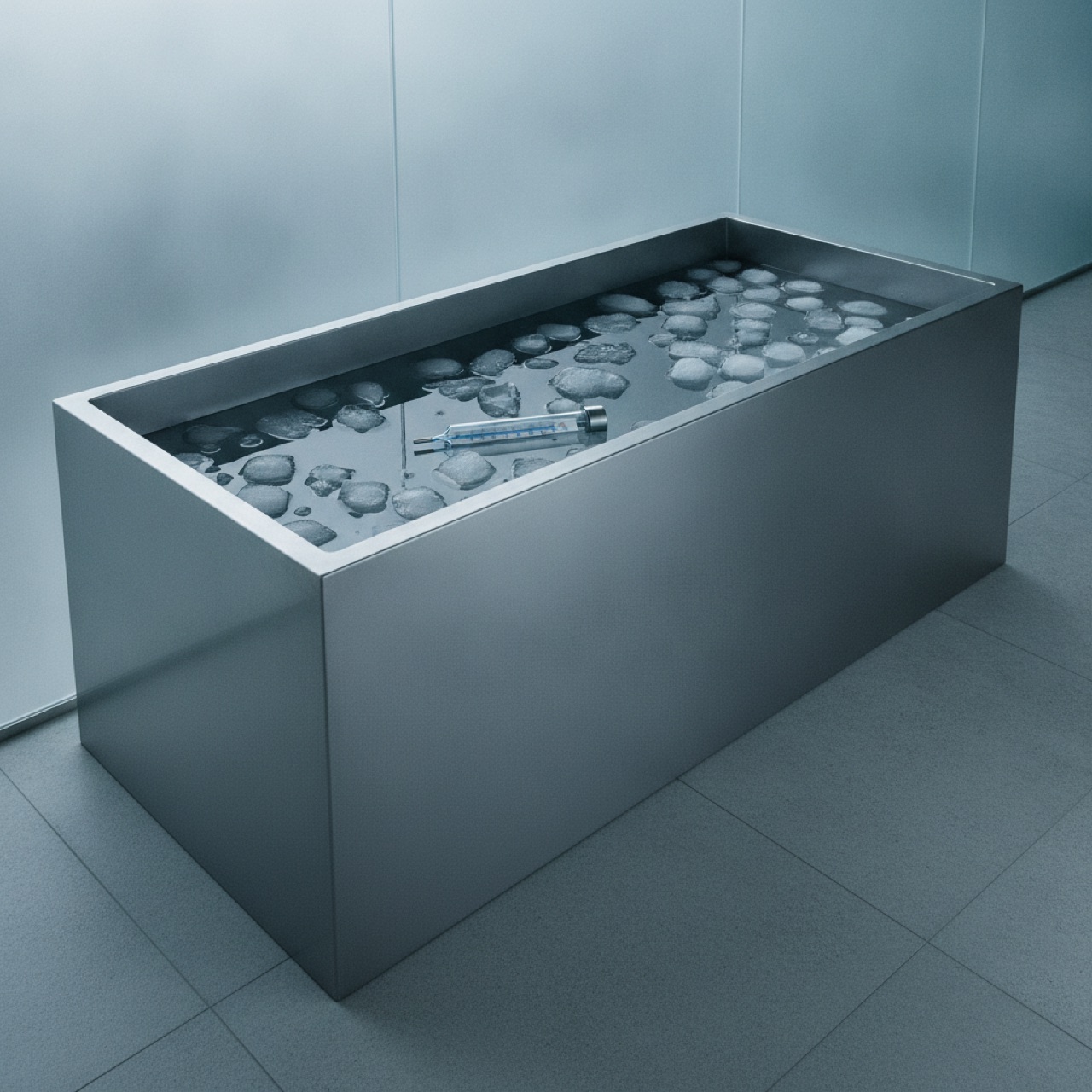
A stable, thermostatically controlled plunge lets you start warmer and hold a known temperature, which is safer than unpredictable ice-bath cold when you are learning how your heart responds.
Safe practice for your heart
For the ranges and habits that keep the cardiovascular stress mild, see: Cold plunge temperature guide and the entry errors to avoid in our common cold plunge mistakes roundup.