Cold Plunge for Seniors:
what changes after 50, and how to start safely.
Age alone does not rule out cold plunging, but it shrinks the margin for error in three specific ways. Vasoconstriction and shivering both weaken with age, so the core cools further and rewarms more slowly. Cardiovascular reserve is lower and heart disease is far more common, so the entry surge in heart rate and blood pressure lands on a less tolerant system. And several medications older adults commonly take, especially beta blockers, mute the responses you would otherwise use to gauge stress. The sensible version for an older beginner is medical clearance first, then warmer water near 59F (15C), 30 to 60 seconds, never alone, and a slow deliberate exit. Expect modest gains in mood, sleep, and joint comfort, and be aware that almost none of the research was done in people your age.
This article is educational and is not medical advice, and it cannot assess your individual risk. Talk to your doctor before starting cold water immersion if you are over 50, and especially if you have any cardiovascular condition, high blood pressure, diabetes, a neurological condition, or take daily prescription medication. If you feel chest pain, an irregular heartbeat, or faintness during a plunge, get out and seek medical help.
How aging changes the cold response
Most cold plunge advice is written as if every body responds to cold the same way. It does not. The defenses your body mounts against cold water are exactly the ones that decline with age, and they decline in a measurable, well-documented pattern. This is not a reason to avoid the tub. It is a reason to know which dials to turn down.
There are two defenses. The first is vasoconstriction: skin blood vessels clamp shut to seal heat inside the core. The second is shivering thermogenesis: muscle generates heat by contracting. Frank and colleagues (2000), publishing in the American Journal of Physiology, cooled eight adults aged 18 to 23 and eight aged 55 to 71 and compared both defenses directly. The older group did not start vasoconstricting until their core temperature had already fallen further (a threshold of about 35.5C versus 36.2C in the younger group), and when the response did arrive it was weaker. Heat production was lower too. Plasma norepinephrine, the signal that drives the clamp-down, rose roughly fourfold in the younger subjects but only twofold in the older ones.
Kenney and Munce (2003), in an invited review in the Journal of Applied Physiology, describe the same picture across the wider literature: reduced ability to conserve heat through cutaneous vasoconstriction, reduced heat production in cold, and less tissue insulation and lean body mass to work with. Sarcopenia matters here in a very concrete way. Shivering is a muscular act, and there is simply less muscle to do it with at 70 than at 30.
A third change gets less attention and deserves more. Thermal perception dulls with age, so the same water feels less cold than it actually is. That breaks the feedback loop most people rely on. If discomfort is what tells you to get out, and discomfort is arriving late, then you are relying on a broken alarm. Use a timer instead.
- ·Skin vessels clamp down later and less forcefully
- ·Norepinephrine release to cold is smaller
- ·Less effective sealing of the body shell
- ·Core temperature falls further before defenses engage
- ·Less muscle mass available to generate heat
- ·Lower peak metabolic heat production in cold
- ·Shivering threshold shifts downward
- ·Slower recovery of core temperature after exit
- ·Cold is felt less sharply for the same stimulus
- ·Subjective discomfort underestimates real cooling
- ·Neuropathy in hands and feet worsens this further
- ·The usual get-out cue arrives late or not at all
Cardiovascular reserve and the cold shock surge
Cold water immersion produces an immediate sympathetic surge: heart rate and blood pressure both climb within seconds. We cover that response in detail in our guide to cold plunge heart rate and blood pressure, and there is no need to repeat it here. What matters for this page is a different question: what does that surge cost a 68-year-old that it does not cost a 28-year-old?
Two things. First, the substrate is different. Coronary artery disease, hypertension, and atrial fibrillation are all far more prevalent after 60, and Shattock and Tipton (2012) argued that an underlying cardiovascular condition, whether a channelopathy or ischemic heart disease, is plausibly what turns a cold shock response from unpleasant into lethal. The mechanism is not unique to older people. The disease that makes the mechanism dangerous largely is.
Second, the reserve is smaller. Reviews of aging and cold stress describe an augmented pressor response in older adults that is not matched by an increase in cardiac output, and a reduced ability to maintain stroke volume when preload and afterload both rise. Put plainly: the pressure goes up, but the heart has less headroom to answer it. The American Heart Association has stated the practical version of this bluntly, noting that the cold shock response can be dangerous for people with existing heart conditions and that severe vasoconstriction in that group can precipitate a myocardial infarction or acute heart failure.
None of this means an older adult with a healthy heart is in danger from a one-minute plunge at 59F. It means the screening step is not optional, and it means starting at the mild end rather than the extreme end is the right call rather than a cautious one.
Thermoregulation, rewarming, and afterdrop
The plunge is not the whole exposure. Core temperature keeps falling for a while after you get out, because cold blood that pooled in the limbs returns to the core once vessels reopen. That is afterdrop, and it is the reason the rewarming period is part of the session rather than an afterthought.
For an older adult, both halves of that equation are worse. Less subcutaneous insulation and weaker vasoconstriction mean the core cools faster during immersion. Weaker shivering means it comes back more slowly afterwards. The result is a longer tail of low core temperature from the same nominal plunge, which is exactly how a session that looked identical to a younger person's ends up being a materially different physiological event.
Practically: dry off immediately, put on more layers than feel necessary, have a warm drink, and move gently for twenty to thirty minutes. Do not jump into a hot shower straight away, which drives another abrupt swing in blood pressure at a moment when you are already vasodilating. And do not plunge outdoors in cold air without a plan for getting warm, because ambient conditions compound everything above. Our guide to how long to cold plunge explains why duration is the variable that drives core cooling, and it is the variable an older beginner should be most conservative with.
Medications that change the picture
This is the section most cold plunge content skips, and it is the one most relevant to anyone over 60. Four drug classes deserve a specific conversation with your prescriber.
- Beta blockers. They blunt the heart rate response to cold. The American Heart Association has noted that this makes it harder to adapt to the adrenergic surge cold shock produces. There is also direct evidence of a muted reflex: in cold face immersion testing, patients on beta blockers showed a smaller heart rate change than controls. The practical problem is not just the physiology, it is that a muffled response removes a signal you would otherwise use to judge how hard the plunge is hitting you.
- Antihypertensives. Cold immersion raises blood pressure sharply on entry and can drop it on rewarming. Drugs that already act on that system change the size and shape of both swings, and the drop on exit is the one that causes lightheadedness and falls.
- Diuretics. Fluid balance and volume status affect how well you tolerate the pressure swing, and dehydration makes the post-plunge blood pressure drop worse. Timing your plunge relative to your dose is a reasonable thing to ask about.
- Anticoagulants. These do not interact with cold water physiologically, but they change the consequences of the most mundane risk in the whole activity: slipping on a wet floor while cold, stiff, and possibly lightheaded. If you take one, non-slip surfaces and a grab rail are not optional equipment.
Sedatives, antidepressants, and drugs affecting alertness belong in the same conversation, because judgment and reaction time matter around water. The rule is simple: if you take something daily, ask before you start rather than after.
Who should not cold plunge after 50
These are the real contraindications. If you are in one of these groups, the general reassurance elsewhere on the internet does not apply to you, and the answer is either no or not without explicit medical direction.
- Recent heart attack, cardiac surgery, stent, or stroke
- Uncontrolled or poorly controlled high blood pressure
- Diagnosed arrhythmia, including atrial fibrillation, or a channelopathy such as long QT syndrome
- Coronary artery disease or significant peripheral vascular disease
- Cold urticaria, which can produce hives and in rare cases anaphylaxis on cold exposure
- Raynaud's phenomenon, where cold triggers painful vasospasm in fingers and toes
- Peripheral neuropathy, including diabetic neuropathy, which dulls the sensation that would warn you of cold injury
- A history of fainting, seizures, or unexplained falls
- Balance or mobility problems that make getting out of a tub unassisted difficult
That last one is not a physiological contraindication, and it is still the one we would weight heavily. A fall on a wet surface is a far more common bad outcome than a cardiac event, and it is the kind of injury that changes an older person's life. Our broader cold plunge side effects guide covers the general risk set that applies at any age.
What older adults may actually gain
Now the honest upside, with the evidence grade attached. The core problem with answering this question is that the cold water immersion literature is built largely on young, fit, mostly male participants, often athletes studied for muscle recovery. Reviewers of that literature repeatedly name homogeneous samples and uncontrolled baseline fitness as limits on generalizability. Extrapolating from a 24-year-old rugby player to a 68-year-old with two prescriptions is not science, it is hope.
What we do have: Cain and colleagues (2025), in a PLOS ONE systematic review and meta-analysis of 11 studies covering 3,177 participants, found that cold water immersion reduced stress, though the effect was measurable only for around 12 hours afterwards, with some signal for sleep quality and general wellbeing and no consistent benefit for mood or immune function. Several of those outcomes rested on single moderate-quality studies, which the authors flagged themselves. Closer to the point, a 2025 pilot study in Frontiers in Public Health combined mindfulness training with cold water immersion in 46 middle-aged and older adults averaging about 61 years across 20 weeks, and reported a positive effect on depression. That is one small pilot with a combined intervention, so it cannot separate the cold from the mindfulness, but it is at least a study of the right people.
Then there is the part that does not need a trial. Cold water hurts less than it distracts, and it produces a short window of reduced joint and muscle discomfort. Regular cold swimming groups provide routine, structure, and social contact, and for an older adult those are not soft benefits, they are among the strongest predictors of wellbeing there are. If the plunge gets you out of the house three mornings a week with people who notice when you do not show up, that is a real return regardless of what the physiology does. Our overview of cold plunge benefits grades the wider claim set the same way.
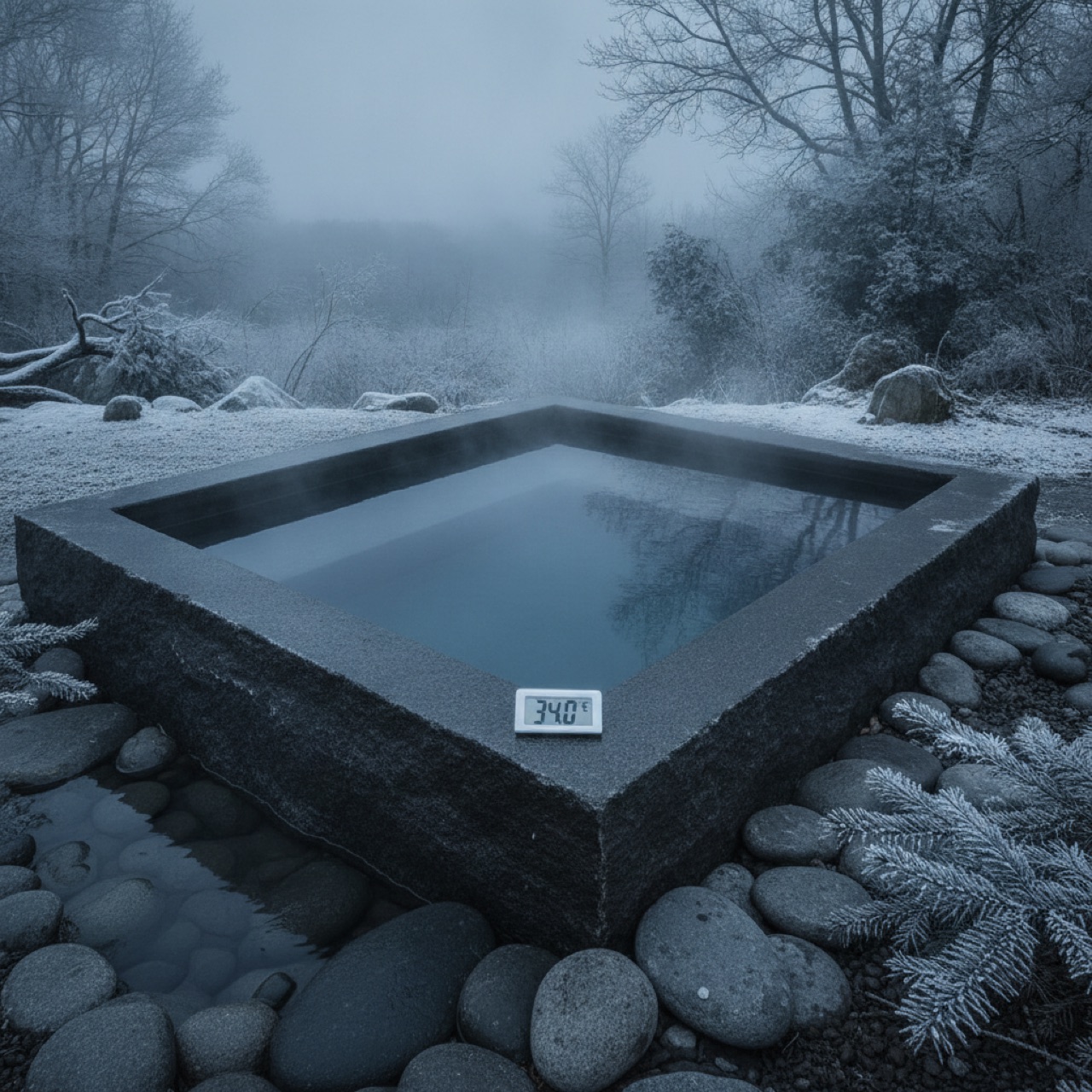
A thermostatically controlled tub lets an older beginner sit reliably at 59F rather than guessing with ice, and a stable known temperature is the single most useful safety feature when your thermoregulatory margin is smaller.
A conservative starting protocol
If you have clearance and none of the contraindications above, here is a deliberately cautious way to begin. It is slower than what you will see online, and that is the point.
A gentler on-ramp is also legitimate. Finishing a normal shower with 30 seconds of cool water for a couple of weeks before you ever get in a tub builds tolerance with almost no risk, and it tells you something about how you respond. Our cold plunge acclimation guide lays out that progression, and the temperature guide gives the ranges you are aiming for.
What to change versus a younger beginner
Side by side, here is what an older beginner should do differently and why. The right-hand column is the physiology, not a preference.
| Variable | Typical young beginner | Suggested for an older beginner | Why it changes |
|---|---|---|---|
| Water temperature | Often 50F (10C) or colder | Start near 59F (15C), rarely below 54F (12C) | Smaller pressure spike, slower core cooling |
| Duration | 2 to 5 minutes | 30 to 60 seconds, ceiling 2 to 3 minutes | Cooling accumulates faster and reverses slower |
| Progression | Weekly, by feel | Every 1 to 2 weeks, by the clock | Thermal perception underreports actual cooling |
| Supervision | Optional | Required, every session | Cardiac and fall risk are both higher |
| Entry style | Step or drop in | Seated, gradual, face dry | Limits the peak cardiovascular demand |
| Rewarming | A towel and a shirt | Layers, warm drink, 20 to 30 minutes | Shivering thermogenesis is weaker with age |
| Medical screening | Sensible | Non-negotiable before session one | Prevalence of cardiac disease rises steeply |
Note: these are conservative general starting points for a healthy older adult with medical clearance, not a prescription. Anyone with a condition listed in the contraindications section should follow their doctor's guidance instead.