In-Ground Cold Plunge:
build routes, real costs and the codes that apply.
An in-ground cold plunge is built one of four ways: poured or gunite concrete, a prefab fiberglass shell, a stainless steel drop-in tub, or a decked-in freestanding plunge. HomeGuide puts inground plunge pools at $10,000 to $70,000 or more installed; a one-person stainless drop-in comes to roughly $26,000 to $34,000 all in. Volume decides the chiller: a 1,200-gallon fiberglass shell needs about ten times the cooling of a 124-gallon stainless tub. Permit it as a pool or spa: a 48 inch barrier or a lockable safety cover, NEC 680 GFCI and bonding, and listed drain covers.
Four ways to build an in-ground cold plunge
The four routes differ most in how much water you end up keeping cold.
1. Poured or gunite concrete
A concrete plunge is formed and poured, or sprayed as gunite, on site, so it can take any shape: a bench at the right depth, steps that double as a seat, a footprint for one or two people. HomeGuide notes that custom concrete pools often take months and that the rougher surface needs more maintenance.
2. Prefab fiberglass plunge shells
A fiberglass plunge pool arrives as one molded shell. Latham's Milan 8.14 is typical: 8 by 14 feet, 4 feet deep, 1,200 gallons, with a non-porous gel coat that Latham says resists algae. HomeGuide's cost table puts fiberglass plunge pools at $20,000 to $50,000 installed. These are small swimming pools, so even a compact shell holds about ten times the water of a one-person tub.
3. Stainless steel built-in tubs, the luxury tier
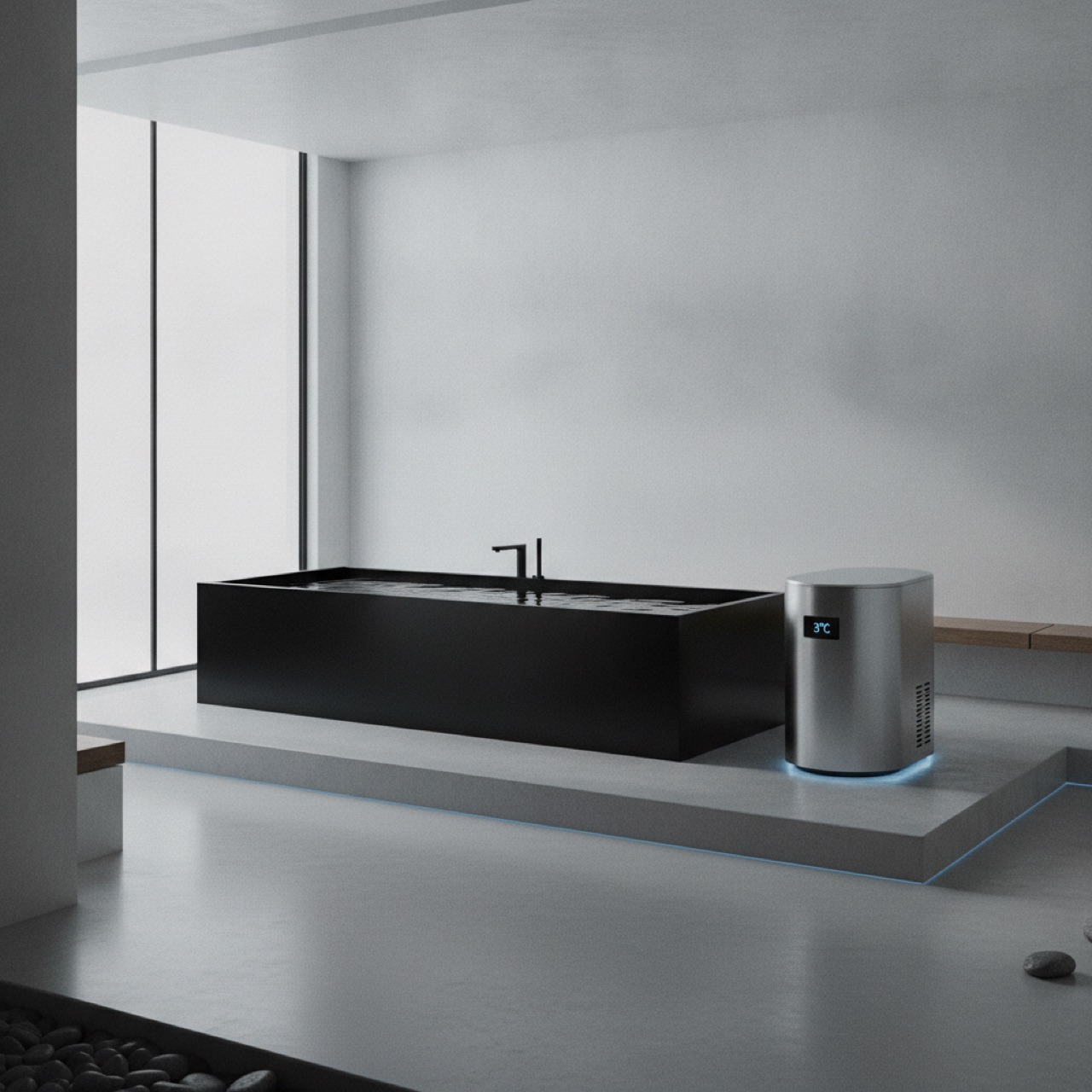
Diamond Spas' standard stainless plunge, the Fraser, comes in an in-ground version designed to drop into a floor, deck or tiled surround. It measures 62 x 44 x 39 inches and holds 124 gallons, with a 316L stainless shell on a 304L frame, a 1/4 HP chiller, UV and hydrogen peroxide sanitation and an R-15 rigid foam cover. The in-ground stainless version starts at $21,330 (copper from $27,990), weighs 1,805 lbs full and needs one 120 V, 20 A GFCI circuit.
4. Sinking or decking-in a freestanding plunge
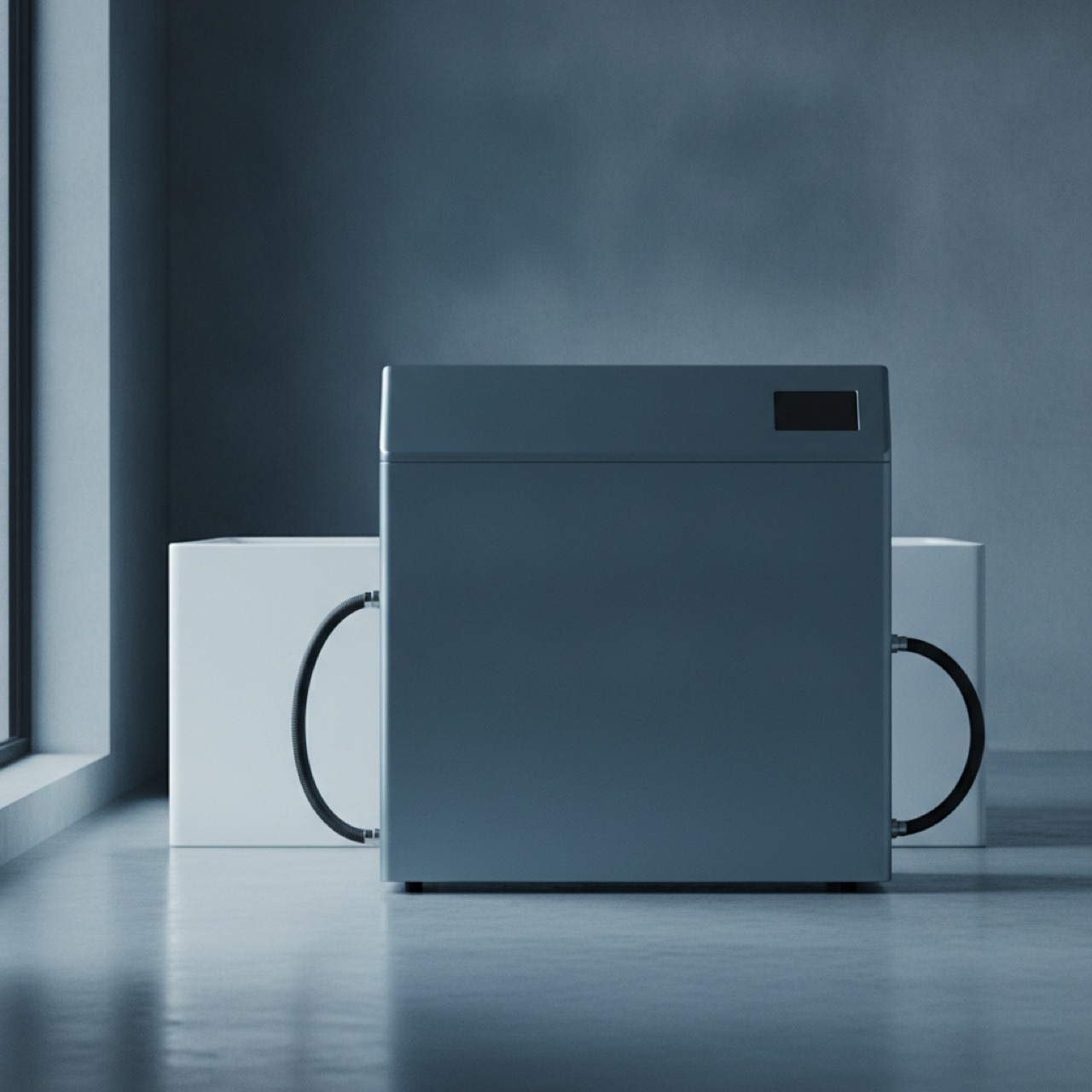
The cheapest built-in look is a freestanding tub with a deck built up to its rim. Renu Therapy specifies at least 27 inches of clearance at the large vent and 15 inches at the small one on its Cold Stoic tubs, and Sun Home gives the same figures for its Cold Plunge Pro and warns of flooding risk around the tank. Lowering a tub into a pit blocks those vents and the service access, so frame the deck around it with removable panels instead. For a DIY version, a stock tank decked in with an external chiller is the budget route; our guide to cheap cold plunge chillers compares units under $800.
Stainless steel vs concrete vs fiberglass cold plunge
Stainless suits one person, concrete a custom shape, and fiberglass a small pool you also want to swim in. Costs are HomeGuide installed figures, except the Fraser's unit price.
| Build route | Water volume | Cost | Build time | Strengths | Watch-outs |
|---|---|---|---|---|---|
| Concrete (poured or gunite) | Custom; 4 x 6 ft with 4 ft of water is about 720 gal | $25,000-$70,000 | Often months | Any shape; foam can go outside the shell | More surface upkeep |
| Fiberglass shell | About 1,200 gal (8 x 14 ft) | $20,000-$50,000 | Faster than concrete | Smooth one-piece gel coat | Pool sizes only; can lift when empty |
| Stainless drop-in | 124 gal (Diamond Spas Fraser) | From $21,330 (unit) | Factory built | Chiller and R-15 cover included | Highest cost per gallon; no salt |
| Decked-in freestanding tub | About 95-150 gal | Tub plus deck | Days | Cheapest; the tub can move later | Vents need 15-27 in of clearance |
On a stainless steel cold plunge, the grade matters. The International Molybdenum Association says 304L should not see chloride above 250 ppm, that 316L tolerates up to about 500 ppm, and that neither belongs in a saltwater pool; SwimEx also recommends against salt sanitizers. Ask for 316L and skip the salt chlorinator.
Size a built-in cold plunge tub for cold, not for swimming
Volume sets chiller size, pull-down time and the power bill, and most plunge pools are drawn around swimming volume. Water weighs about 8.34 lbs per gallon and takes about 1 BTU to change 1 lb by 1F.
Concrete basin, 4 x 6 ft with 4 ft of water: 96 cu ft x 7.48 = 718 gal, 5,988 lbs, about 89,800 BTU.
Fiberglass shell, 1,200 gal: 10,008 lbs, about 150,100 BTU.
Penguin Chillers rates its 1.5 HP chiller at 15,000 BTU/hr. At that rate, before any heat leaks back in, the three take about 1, 6 and 10 hours.
Penguin's 3/4 HP Cold Therapy Chiller, rated at 7,500 BTU/hr, would need about 20 hours for the fiberglass shell; our Penguin Cold Therapy Chiller review covers that tub-sized unit. Above a few hundred gallons you are buying pool-scale or commercial units: Penguin lists 2-ton commercial water chillers from $6,999.99 on its own store in October 2026.
So size the basin for the people who plunge at once, seated with water at the collarbone. A long bench or a sun ledge is water you pay to chill every day.
Site and excavation: frost, groundwater and drainage
Check frost, groundwater and runoff before anyone digs, in this order.
Pool Research explains that a full pool's water balances the groundwater pressing from outside; drain it, especially after heavy rain, and the outside pressure wins. Many pools have hydrostatic relief valves in the floor that let groundwater in while the shell is empty, and Pool Research advises opening them when draining and never draining after a storm. If you plan full water changes, specify one.
Does the ground keep an inground cold plunge colder?
It helps in summer and works against you in winter. The US Energy Information Administration puts the earth 10 feet down at a steady 50F to 60F. Shallower soil still follows the seasons; an NREL presentation for the Department of Energy notes that ground temperature stabilises around 30 feet down, near the area's average annual air temperature.
In July the soil around a 4 foot shell is cooler than the air and the walls are out of the sun, so it gains less heat than a tub on a patio. But that soil is warmer than 45F water, so heat still flows in all year, and in winter the ground is warmer than the night air that cools an above-ground tub for free. The ground is a buffer, not a chiller.
Insulating the shell
Insulate every face you can reach before backfill, then cover the water. Green Building Advisor lists EPS foam at about R-3.6 to R-4.2 per inch, XPS at R-5 and polyiso at R-5.7 to R-6, but notes that polyiso resists heat flow less well as temperatures drop. Two inches of XPS gives about R-10. The water surface is the one face the ground never shields: Diamond Spas ships the Fraser with an R-15 cover, and a lockable cover that meets ASTM F1346 can also count toward your barrier requirement.
Equipment pad, chiller plumbing and drain safety
Put the pad close, above the waterline if you can, and plumb it like a pool:
- The SwimEx plunge manual allows filtration equipment up to 50 feet away. Below the waterline, fit check or ball valves against siphoning; the ISPSC requires shutoff valves on both sides of any pump below the waterline.
- SwimEx's split chiller needs its remote condenser within 75 feet, in a ventilated spot, on a 208-240 V, 20 A circuit for the smaller model.
- A potable water fill needs a backflow preventer, and the drain needs an air gap.
- The APSP-15 circulation standard caps pipe velocity at 8 feet per second on returns and 6 on suction.
The Virginia Graeme Baker Pool and Spa Safety Act requires drain covers to meet ASME/ANSI A112.19.8 or its successor, ANSI/APSP/ICC-16, codified at 16 CFR part 1450, and requires public pools and spas with a single blockable drain to add a second anti-entrapment system. CPSC says residential pools are not required to install these but they are highly recommended. A plunge with one low suction fitting feeding a chiller pump is that single blockable outlet, so use a listed cover rated for the pump's flow and split suction across two outlets at least 3 feet apart, or draw through a skimmer.
Codes and permits: a cold plunge pool is a pool
Expect a built-in plunge to be permitted as a pool or a spa. CPSC's barrier guidelines state that the definition of a pool includes spas and hot tubs, and where the International Swimming Pool and Spa Code (ISPSC) is adopted, its barrier rules apply.
- Barrier: ISPSC 2021 Section 305.2.1 puts the top of the barrier at least 48 inches above grade on the outside, with no more than 2 inches of clearance under it over grass or gravel and 4 inches over concrete. CPSC notes some places require 60 inches.
- Cover exception: the ISPSC exempts spas and hot tubs with a lockable safety cover complying with ASTM F1346, and pools with a powered cover to the same standard. Whether your basin counts as a spa is the building official's call, and local amendments vary.
- GFCI: the 2023 NEC requires GFCI protection on outdoor outlets at homes, and NEC 680 sets receptacle distances from the pool wall, 6 feet for general receptacles in the 2014 text.
- Bonding: as IAEI Magazine summarises it, pools, spas and hot tubs are bonded with solid copper of at least 8 AWG, including structural reinforcing steel and perimeter surfaces within 3 feet of the inside walls.
Permits run $400 to $1,800 according to Bob Vila's cost guide and $500 to $2,000 according to HomeGuide. Use a licensed electrician; our outdoor cold plunge guide covers the outdoor GFCI rule.
What an in-ground cold plunge costs
The shell is the biggest line; in the example below, site work, wiring, permits and the deck add about $4,500 to $13,000. None of the plunge pool cost guides price a chiller, because they assume a swimming pool.
| Line item | Typical cost | Source |
|---|---|---|
| Concrete plunge pool, installed | $25,000-$70,000 | HomeGuide |
| Fiberglass plunge pool, installed | $20,000-$50,000 | HomeGuide |
| Stainless drop-in with chiller | From $21,330 (Fraser, in-ground) | Diamond Spas |
| Site prep and excavation | $1,500-$5,000 | Bob Vila |
| Concrete slab | $6-$12 per sq ft | HomeGuide |
| Chiller | $1,949.99 (7,500 BTU/hr) to $2,599.99 (15,000 BTU/hr) | Penguin Chillers |
| Electrician | $50-$130 per hour | HomeGuide |
| Permits | $400-$2,000 | Bob Vila; HomeGuide |
| Deck or patio | $25-$50 per sq ft (deck), $5-$35 (patio) | HomeGuide |
| Barrier fence | $20-$60 per linear ft | HomeGuide |
Site prep and excavation: $1,500-$5,000.
Slab under a pit 2 ft larger all round, about 70 sq ft at $6-$12: $420-$840.
One 120 V, 20 A GFCI circuit, assuming 4-8 hours of electrician time: $200-$1,040.
Permits: $400-$2,000. Deck, 80 sq ft at $25-$50: $2,000-$4,000.
Total: about $25,850-$34,210, plus $800-$2,400 for 40 feet of fence if the cover does not exempt you.
For a 720-gallon concrete basin, the shell alone starts at HomeGuide's $25,000 floor, before a $2,600 chiller sized for the volume and the fence.
How cold should a cold plunge pool be?
Most people run a cold plunge pool at 50F to 59F, the range Diamond Spas calls ideal. Start near the top and work down over weeks; experienced plungers go to 45F to 50F. Our cold plunge temperature guide breaks it down by level. Size the chiller to hold your setpoint in August, not on the day you fill it.
Maintaining a built-in plunge
You cannot tip a built-in plunge out like a tub, so run it like a small hot tub. CDC's hot tub guidance calls for free chlorine of at least 3 ppm or bromine at 4-8 ppm, and pH 7.0 to 7.8. SwimEx recommends at least 8 hours of filtration a day. Keep the cover on between sessions, and drain only in dry weather with the relief valve open.
When a freestanding tub is the smarter choice
For most homes a freestanding tub wins on cost, speed and flexibility. Sun Home lists its Cold Plunge Pro at $13,999 and Renu Therapy its Cold Stoic 2.0 from $9,499 on their own stores in October 2026, chillers built in. Choose freestanding if:
- Your all-in budget is under about $25,000. Our Sun Home Cold Plunge Pro review and Renu Cold Stoic review cover two premium tubs well below that.
- You rent or may sell within a few years. An in-ground plunge stays with the house.
- You want to plug in this month. Jacuzzi's Kodiak cold plunge is a plug-and-play contrast tub.
- You want hot and cold without two excavations; see our guide to hot tub and cold plunge combos.
Go in-ground when the plunge is part of a landscape you will keep for decades, when you want stainless or custom concrete, or when two or more people plunge together every day.
Frequently asked questions
How much does an in-ground cold plunge cost?+
Is an in-ground cold plunge colder than an above-ground one?+
Do I need a fence around an in-ground cold plunge?+
What size chiller does an in-ground cold plunge need?+
Is stainless steel or concrete better for a cold plunge?+
Can I sink a freestanding cold plunge tub into the ground?+
Sources
What this page relies on. Specifications and prices from manufacturer pages change often, so check the brand before you buy.
- Diamond Spas. Standard cold plunge tub, The Fraser (above-ground and in-ground): product page and specifications. diamondspas.com.
- Latham Pool Products. Fiberglass plunge pool collection (Milan 8.14 dimensions, depth and gallons). lathampool.com.
- Farmer T, HomeGuide (2025). How much does a plunge pool cost?. homeguide.com.
- Flannery K, Bob Vila (2022). How much does a plunge pool cost?. bobvila.com.
- International Molybdenum Association. Stainless steel in swimming pools and spa tubs. imoa.info.
- SwimEx (2024). Residential plunge tanks installation manual. swimex.com.
- Renu Therapy. Product specifications and dimensions, including Cold Stoic vent clearances. renutherapy.com.
- Sun Home Saunas. Cold Plunge Pro: important information (clearances and placement). sunhomesaunas.com.
- US Geological Survey Water Science School. Water density. usgs.gov.
- US Geological Survey Water Science School. Specific heat capacity and water. usgs.gov.
- Penguin Chillers. 1 1/2 HP water chiller: product page. penguinchillers.com.
- Penguin Chillers. Cold Therapy Chiller: product page and specifications. penguinchillers.com.
- Dean M, Pool Research (2024). Pool popping out of the ground? Here is what to do. poolresearch.com.
- US Energy Information Administration. Geothermal heat pumps. eia.gov.
- Anderson ER, National Renewable Energy Laboratory (2010). DOE webinar: residential geothermal heat pump retrofits (NREL/PR-6A10-50142). energy.gov.
- GreenBuildingAdvisor. Choosing rigid foam. greenbuildingadvisor.com.
- International Code Council and the Association of Pool & Spa Professionals (2018). What you need to know about the International Swimming Pool and Spa Code (ISPSC). iccsafe.org.
- International Code Council (2021). 2021 International Swimming Pool and Spa Code, Chapter 3, Section 305: barrier requirements. codes.iccsafe.org.
- US Consumer Product Safety Commission (2023). Safety Barrier Guidelines for Residential Pools (Publication 362). cpsc.gov.
- US Consumer Product Safety Commission. Pool and spa drain covers: business guidance (Virginia Graeme Baker Pool and Spa Safety Act). cpsc.gov.
- Eaton. GFCI 210.8(F): outdoor outlets under the 2023 NEC. eaton.com.
- NEC text reproduced for electrician continuing education. NEC 680.22(A)(1): required receptacle, location. electricallicenserenewal.com.
- Short R, IAEI Magazine (2023). Grounding and equipotential bonding of swimming pools. iaeimagazine.org.
- US Centers for Disease Control and Prevention. What you can do to stay healthy in hot tubs. cdc.gov.
- Sun Home Saunas. Sun Home Cold Plunge Pro: product page. sunhomesaunas.com.
- Renu Therapy. Cold Stoic 2.0: product page. renutherapy.com.