Cold Plunge for Runners:
you have more freedom than lifters do.
Cold water immersion reduces soreness after hard running compared with doing nothing (Bleakley et al. 2012), and the fear that it wrecks your training does not transfer cleanly from lifting to running. The blunting evidence is strong for strength and hypertrophy (Roberts et al. 2015) and weak for endurance adaptation (Broatch, Petersen and Bishop 2018). Use it tactically after marathons, downhill sessions and back-to-back races at 50 to 59F (10 to 15C) for 5 to 10 minutes. Skip it after your key strength work and after ordinary easy mileage.
Should runners cold plunge?
Most cold plunge advice aimed at athletes was written for lifters, and it has left runners with the wrong instinct. The warning that dominates the conversation, that ice baths blunt your gains, comes almost entirely from resistance training research. Applied to a marathon build, it is at best a poor fit and at worst it talks runners out of a tool that suits their sport better than it suits the sport it was studied in.
The running case is different in three ways. First, the tissue insult is different. A long run or a hilly race produces eccentric muscle damage across a huge volume of muscle, and eccentric damage is exactly the kind of soreness cold immersion handles best. Second, the adaptation you are protecting is different. A runner is chasing mitochondrial density, capillarisation and running economy, not cross-sectional area, and cold appears to interfere far less with the first set than the second. Third, the competition calendar is different. Runners race, sometimes twice in a weekend, and the case for cold is strongest when you have to perform again soon.
This guide is running specific. For the general recovery picture across all sports, we cover the mechanisms and the ranking against sleep and active recovery in our guide to cold plunge for muscle recovery.
Soreness after long runs: what the evidence shows
The anchor evidence is the 2012 Cochrane systematic review by Chris Bleakley and colleagues, which pooled 17 randomised trials covering 366 participants. Fourteen of those trials compared cold water immersion after exercise against passive recovery, meaning rest or nothing. The finding: cold immersion reduced delayed onset muscle soreness at 24, 48, 72 and 96 hours after exercise.
That result matters to runners because delayed onset muscle soreness is the signature complaint of the long run and the downhill race. It peaks a day or two out, it makes stairs miserable, and it is the reason Monday after a marathon feels the way it does.
The Cochrane authors were blunt about the limits. Study quality was low. The trials varied widely in water temperature, immersion duration and exercise protocol, which makes a single recommended dose impossible to extract from the pooled data. There was not enough evidence to conclude anything about other outcomes, or about cold immersion versus other active recovery approaches. And you cannot blind a participant to whether they sat in cold water, so expectation contaminates every trial in the set.
Running-specific work fills in the picture without overturning it. In a downhill running protocol using a 30 minute run at a 15 percent decline, a group given 10 minutes of immersion at 15C lost roughly 5 percent of muscle torque, a non-significant drop, while the control group lost around 11 percent. On the other side, a 2022 randomised placebo-controlled trial in marathon runners combining cold water immersion with tart cherry juice found no statistically significant differences between treatment groups on the inflammation and muscle damage markers measured, and no additive benefit from stacking the two.
Read together, the honest summary is that cold immersion reliably makes hard running hurt less over the following days, and that its effect on the underlying tissue repair is smaller and less certain than the soreness numbers suggest. The mechanisms behind that gap, vasoconstriction, reduced swelling and dampened pain signalling, are covered in our guide to cold plunge and inflammation.
Endurance vs strength adaptations: the asymmetry
This is the section that should change how you think about ice baths, because the popular version of the science flattens a real distinction.
The blunting case is well established for lifting. Roberts and colleagues, publishing in the Journal of Physiology in 2015, put 21 physically active men through 12 weeks of strength training twice a week, with either 10 minutes of cold water immersion or 10 minutes of active recovery after each session. The immersion group gained less strength and less muscle mass, and biopsies showed blunted satellite cell activity and reduced anabolic signalling. That is a well-designed longitudinal trial with a mechanism attached, which is why it dominates the discussion.
The endurance evidence does not look like that. Broatch, Petersen and Bishop reviewed the literature in Sports Medicine in 2018 and reached a two-part conclusion: cold immersion can attenuate physiological adaptations to resistance training, including maximal strength, power and hypertrophy, without negatively influencing endurance training adaptations. Their reading of the acute data was that immersion may actually augment endurance signalling pathways and mitochondrial biogenesis genes after a single session, while producing little to no change in mitochondrial protein content after long-term training.
The controlled test supports that. Broatch and colleagues (2017), writing in the American Journal of Physiology, ran 19 men through a single sprint interval session and 16 of them through six weeks of sprint interval training, each with either immersion at 10C or a room-temperature control afterwards. Regular immersion produced no change in PGC-1 alpha or p53 protein content, and no detriment to peak aerobic power, VO2max, mitochondrial respiration or time trial performance.
Where it gets genuinely conflicted is the mechanistic signal. Ihsan and colleagues found the opposite direction, reporting that post-exercise immersion increased PGC-1 alpha messenger RNA in the immersed limb relative to a non-immersed limb performing identical work, and that four weeks of regular immersion during endurance training raised PGC-1 alpha protein along with several mitochondrial proteins. Ihsan, Abbiss and Allan later titled a 2021 Frontiers review on the topic "Friend, Foe, or Futile?", which is a fair summary of where the field sits.
One caveat runners routinely miss: your strength work counts as strength work. If you lift twice a week for injury resilience and economy, the Roberts findings apply to those sessions directly. Our guide on cold plunging before or after a workout lays out the scheduling logic for keeping cold away from the sessions where it costs you something.
Race week and back-to-back racing
The strongest practical case for a runner's ice bath has nothing to do with long-term adaptation. It is about performing again within hours or days.
Versey, Halson and Dawson reviewed water immersion recovery for athletes in Sports Medicine in 2013 and framed the value precisely this way: accelerated short-term recovery, over hours to days, can improve competition performance and allow greater training loads. That is the tournament model, and it maps onto several running situations directly. A Saturday parkrun followed by a Sunday race. A track meet with heats and a final. A multi-day stage or trail event. A marathon build where the day after the long run carries a session you do not want to abandon.
In those cases the calculus flips. You are not trying to maximise the adaptive signal from the session you just finished, you are trying to be able to run tomorrow. Feeling fresher is the outcome, and it is a legitimate one even if a good share of it is perceptual. Perceived readiness determines what you attempt, and what you attempt determines what you actually train.
Race week itself needs less caution than people assume. During a taper you are not building anything, so the theoretical adaptation cost is close to zero. If a hard tune-up session leaves your legs beaten up six days out, a plunge is a reasonable way to clear soreness faster. What it should not become is a nightly ritual through taper week, which mostly adds a novel stressor and a sleep disruption to a week you want to be boring.
Pre-cooling before racing in the heat
This is a separate application with its own evidence base, and it is arguably the best supported use of cold water for a runner. Pre-cooling means lowering body temperature before the start so you have more thermal headroom during the race.
Bongers and colleagues published a meta-analytical review in the British Journal of Sports Medicine in 2015 covering 20 pre-cooling studies and 8 studies of cooling during exercise. The overall effect on performance in the heat was an improvement of roughly 6.7 percent, an effect size of about 0.43. That is a large effect by the standards of anything else you can legally do to a race. Notably, the authors found that core temperature, skin temperature and heart rate did not shift reliably, and no correlation existed between thermophysiological changes and the performance gain, which points toward perceptual and thermal-comfort mechanisms doing meaningful work.
Practical translation for a hot race. A short immersion, 5 to 10 minutes at 10 to 15C, finished 20 to 30 minutes before the start, gives you the heat storage benefit while leaving time for muscle temperature to normalise before the gun. Do not plunge and then step straight to the line, because cold muscle produces less force and pre-exercise cooling of the working muscle can reduce power output. Warm up normally afterwards. Cold water is also not the only option here, and for many amateur races an ice slurry drink or a cooling vest is far more logistically realistic than hauling a tub to the start area.
Pre-cooling only earns its place when the race is genuinely hot. In cool conditions it is a solution to a problem you do not have, and it costs you warm-up quality.
The runner's protocol
A runner's recovery plunge is not the same dose as a two minute morning dip for alertness, and it is not the same dose as a team sport protocol either. Here is what the research ranges support.
If you want the full reasoning behind those two numbers rather than the summary, we break them down in our guides on cold plunge temperature and how long to cold plunge.
One practical note specific to runners: your feet and lower legs take the worst of it. Calves and ankles have little insulating tissue and a lot of surface area, so the first two minutes are harder than the discomfort of the same water at the same temperature felt around the thighs. Neoprene socks are a reasonable compromise if foot pain is the thing ending your immersion early, and they cost you very little of the effect, since the target tissue is the large muscle of the leg.
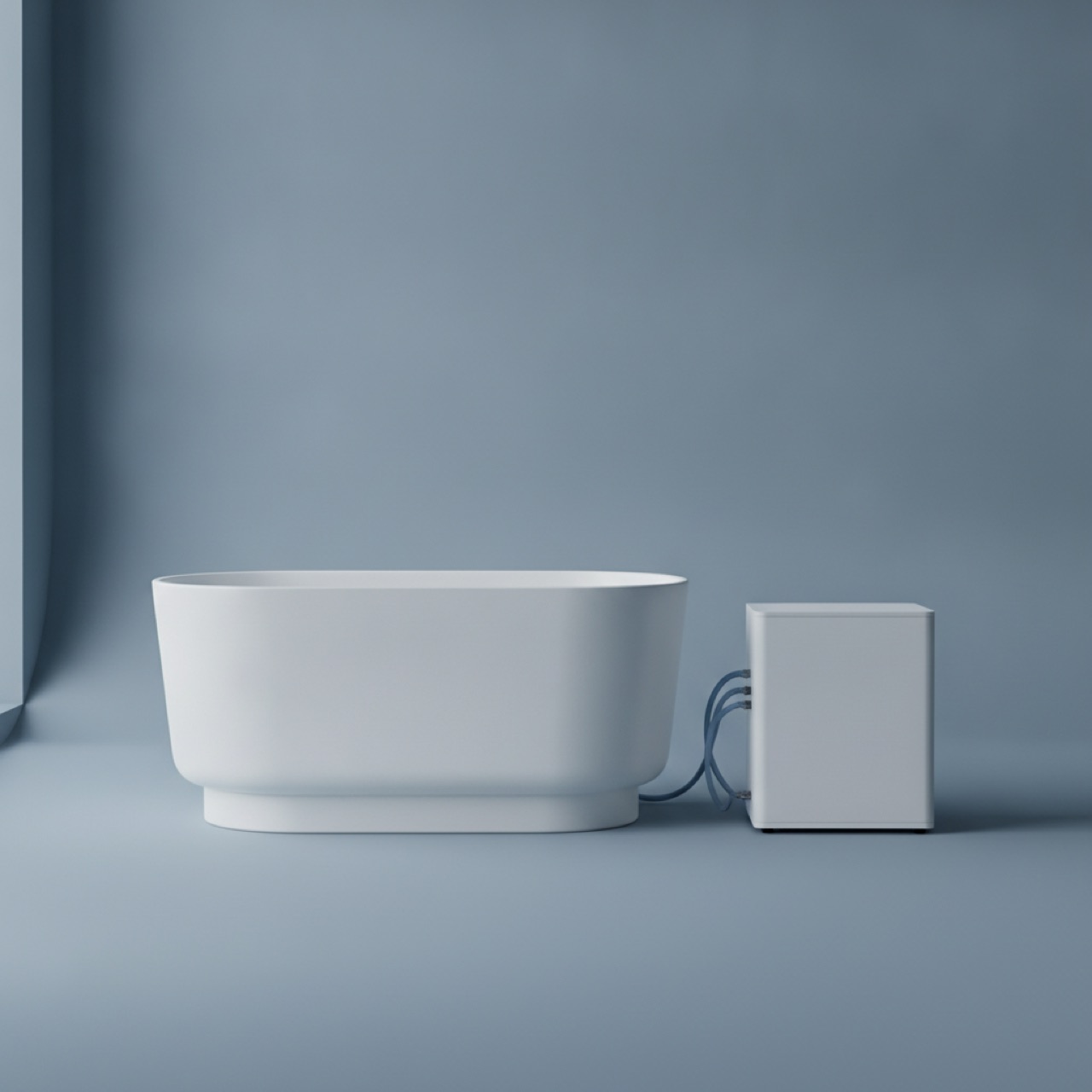
An upright barrel keeps you seated with legs fully submerged in a small footprint, which suits leg-focused running recovery better than a full-length tub. No chiller, so you are adding ice per session.
Scenario table
A quick reference for matching the decision to the situation. These are general guidelines from the research ranges, and individual response varies more than any table can capture.
| Scenario | Temperature | Duration | Timing | Verdict | Why |
|---|---|---|---|---|---|
| Marathon or ultra finish | 50-59°F / 10-15°C | 8-10 min | Same evening | Worth it | Large muscle damage load, no adaptation to protect |
| Hard downhill / trail session | 50-59°F / 10-15°C | 8-10 min | Within 1 hr | Worth it | Eccentric damage is what responds best |
| Back-to-back race days | 50-55°F / 10-13°C | 10 min | Post-race | Worth it | Readiness beats adaptation this week |
| Ordinary long run, base block | n/a | n/a | Skip | Not worth it | Modest benefit, easy run does the same job |
| Pre-race in heat | 50-59°F / 10-15°C | 5-10 min | Finish 20-30 min pre-start | Situational | Pre-cooling, not recovery (Bongers 2015) |
| After key strength session | Avoid | n/a | Delay 6+ hrs or skip | Avoid | Blunts strength adaptation (Roberts 2015) |
| Taper week, no soreness | n/a | n/a | Skip | Not worth it | Nothing to recover from |
Note the two "not worth it" rows. Most of the value in cold immersion for runners comes from a small number of high damage or high congestion situations, not from consistency.
When not to plunge
The decision to skip is as much a part of the protocol as the temperature. Five situations where a runner is better off out of the water.
For the wider list of upsides and where the evidence is strongest overall, see our overview of cold plunge benefits.