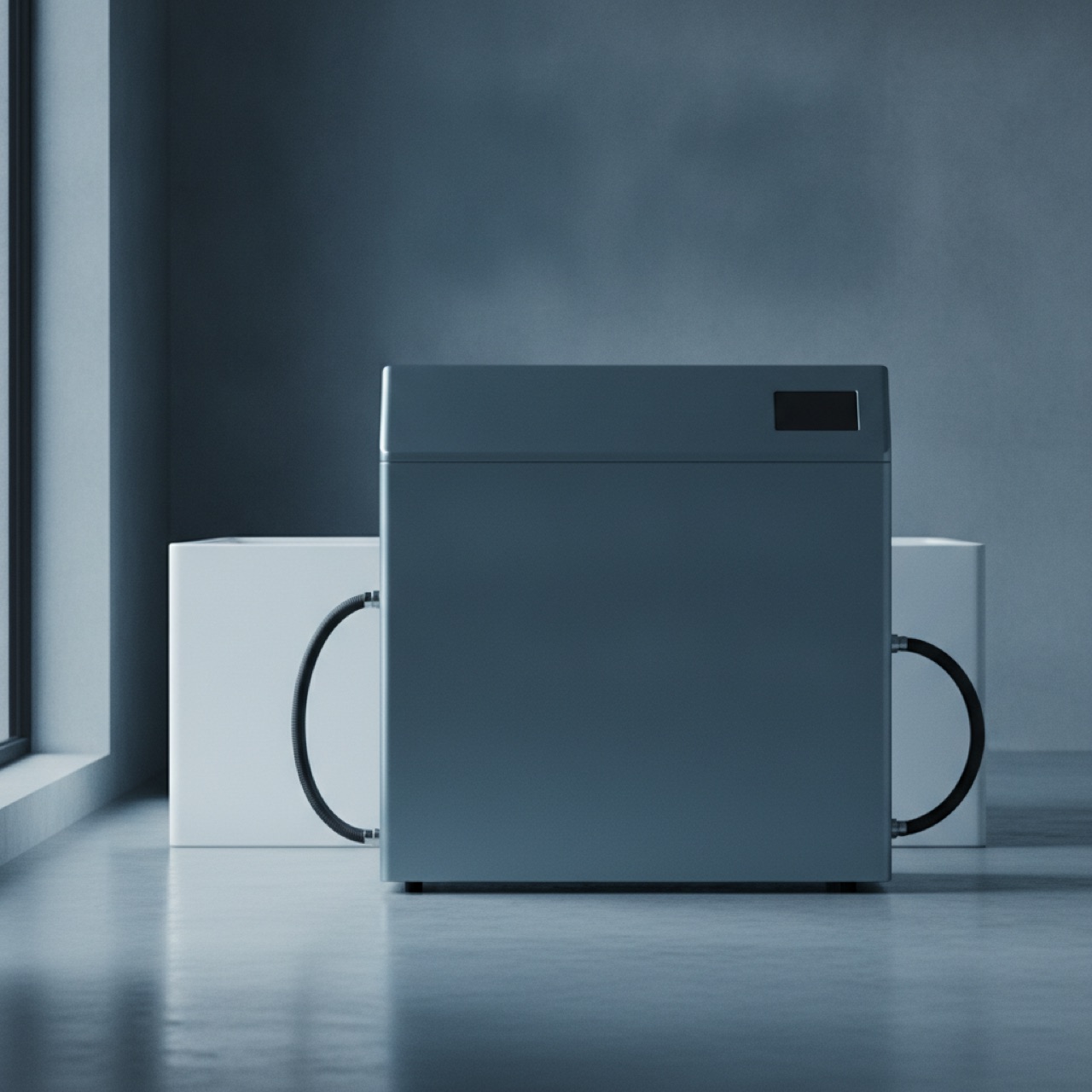
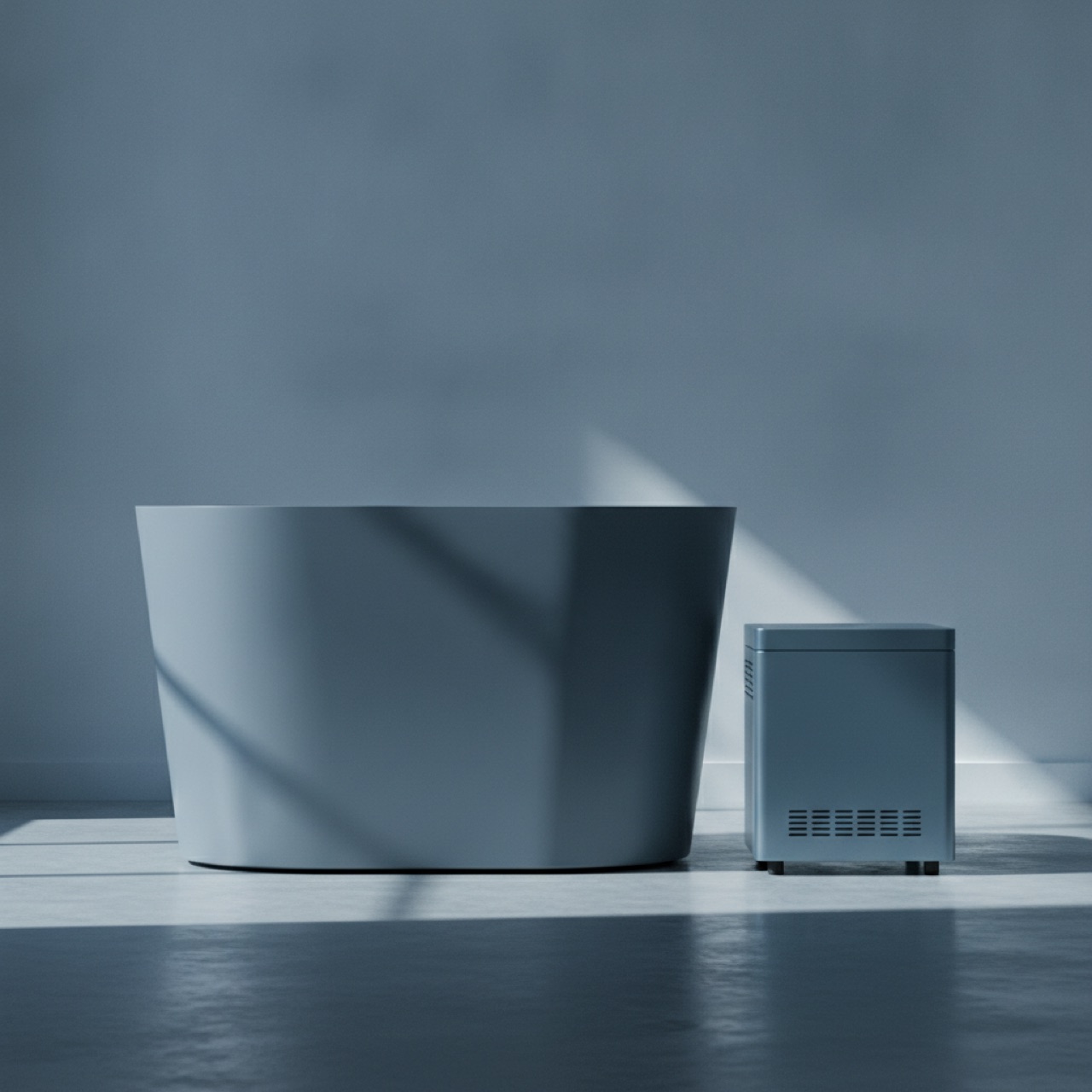
What Cold Plunge Does Joe Rogan Use?
Two machines, two locations. A factual breakdown of Rogan's home Morozko Forge Pro, his JRE studio BlueCube, the protocol he has described publicly, what Andrew Huberman told him on-camera about the science, and whether any of it should inform what you buy.
Joe Rogan uses two cold plunges: a Morozko Forge Pro at his Austin home, set to approximately 33-34F - cold enough for ice to form on the surface - and a BlueCube Cold Plunge Pro (~$19,000) at his JRE studio, which uses RiverMode circulating water rather than ice formation.
His protocol: approximately 2-3 minutes, 5+ mornings per week, almost always after sauna. He reports mental clarity, mood lift, and recovery benefits. Most published research on cold immersion uses 50-59F - Rogan's 33-34F is well outside the studied range, and there is no evidence it produces superior outcomes.
The Morozko Forge Pro: Rogan's home setup
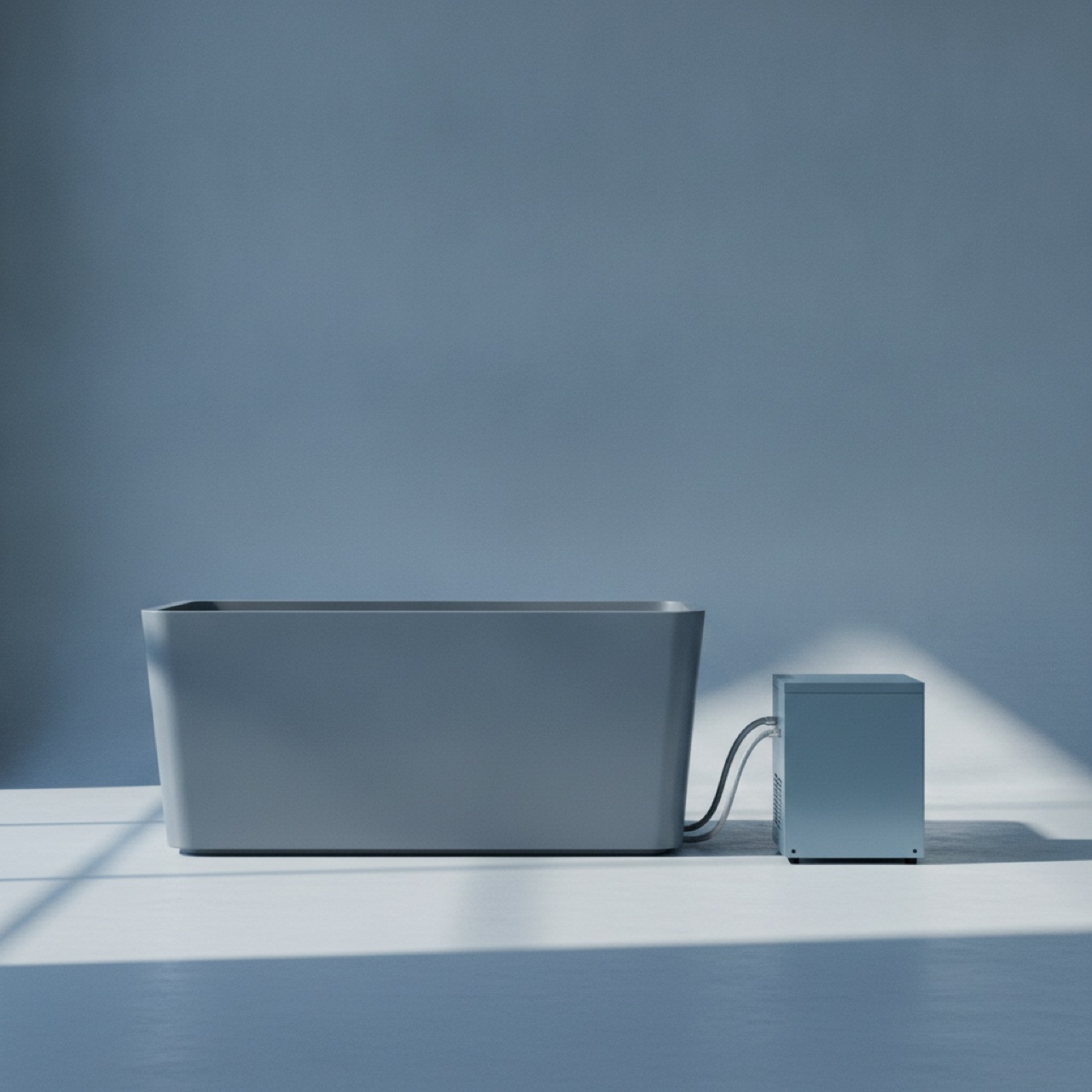
The Morozko Forge is not a standard chiller-based cold plunge. It is a full refrigeration system that uses a compressor, condenser, and submerged evaporator coil to pull heat from the water aggressively enough to form actual ice on the surface while keeping the bulk of the water liquid and circulating. Most cold plunge systems on the market cool to 37-39F at minimum; the Forge Pro sustains temperatures at or just above the literal freezing point of fresh water.
Morozko's website explicitly markets it as "the ice bath Joe Rogan uses every morning." That phrasing is accurate - Rogan has discussed the unit by name on multiple JRE episodes, and the brand has leaned heavily on this association. This is worth knowing when evaluating their marketing materials.
The unit runs on a standard 120V connection, includes a high-volume ozone water treatment circuit, and is manufactured in the United States. In Rogan's home gym setup it sits adjacent to his barrel sauna, making the sauna-to-cold transition a matter of a few steps.
BlueCube Cold Plunge Pro: the JRE podcast studio unit
At his podcast studio, Rogan keeps a BlueCube Cold Plunge Pro, priced at approximately $19,000. Unlike the Morozko Forge, the BlueCube does not form ice. Its distinguishing feature is RiverMode: a system of jets that keeps the water in constant circulation rather than letting it sit still.
This distinction matters physiologically, and Andrew Huberman has discussed it directly on JRE at this exact unit (episodes #1958 and #2195). When you enter still cold water, a thin warm thermal layer forms immediately around your skin - the body's heat is conducted into the surrounding water and briefly creates a slightly warmer microenvironment against the skin. Still water allows this layer to partially insulate you. Moving water continuously disrupts this layer, which makes the effective cold exposure more intense even at the same absolute water temperature.
The studio setup serves a different function than the home unit. When health-focused guests appear on JRE - which is frequent - both Rogan and his guests have access to actual plunge experience rather than theoretical conversation. Huberman and Rogan have discussed cold protocols sitting at the BlueCube on camera, which is where some of the most specific scientific content on cold in any podcast format has been recorded.
Rogan's exact protocol
Based on multiple JRE episodes, Rogan's cold plunge practice has these consistent elements:
What Rogan claims from his practice is experiential, not medical: mental clarity, mood elevation, recovery from training, and what he describes as a general sense of resilience. He frames it as something he does because it is hard and because he feels better for it. He is not making clinical claims about disease treatment or specific biochemical mechanisms in most of his descriptions - he is reporting subjective experience, which is a different and much more defensible thing.
He has repeatedly noted that beginners should not start at his temperature. The 33-34F setting represents years of progressive cold adaptation, not a starting point.
Key JRE episodes on cold exposure
The cold content on JRE spans many episodes, but four are the most substantive. Each covers distinct ground.
Cold exposure as stress adaptation. Breathwork as a primary tool for cold tolerance. Hof describes cold as a teacher for controlling the autonomic nervous system, and demonstrates breathing exercises that suppress the cold shock response. Most of the cold discussion here is psychological and experiential rather than mechanistic.
The Iceman method in more detail. Cold water swimming, mental control. Hof discusses immune system activation from cold - a claim with some research support from his own published experiments (Kox et al., 2014, PNAS) but that has not been fully replicated at scale. More of a philosophy-and-method episode than a research-driven one.
This is where the most specific science on cold exposure has appeared in podcast format. Huberman explains the Soebrg Principle (minimum dose concept), the thermal layer effect in still versus moving water, and the sequencing of sauna and cold. Recorded at Rogan's JRE studio BlueCube, so the conversation happens in context.
Continued protocols discussion. Cold timing relative to exercise - specifically the finding that cold after strength training blunts hypertrophy. The sauna-cold protocol for growth hormone - and importantly, the finding that cold after sauna blunts the growth hormone response you would otherwise get from the sauna alone. Nuanced and often under-cited.
What Huberman told Rogan about the science of cold
Several findings that Huberman discussed on JRE are worth highlighting specifically, because they are often paraphrased inaccurately elsewhere:
Named after researcher Susanna Soeberg, this refers to research suggesting that approximately 11 minutes of cold immersion per week - distributed across 2-4 sessions - is a threshold for meaningful metabolic adaptation. This does not mean 11 minutes is optimal or that more provides no benefit. It means 11 minutes of actual immersion time per week is a reasonable evidence-based minimum rather than an arbitrary guess. Three sessions of about 4 minutes each, or four sessions of about 3 minutes, would meet this threshold.
Huberman explained this directly at the BlueCube studio. Still cold water allows a warm thermal layer to form against the skin, which partially insulates you. Moving water - as in the BlueCube's RiverMode - continuously disrupts this layer, making the effective exposure more intense. This is why the temperature setting alone does not fully describe the difficulty or stimulus of a cold immersion. Two people at 50F in still versus circulating water are having meaningfully different physiological experiences.
This is a nuanced point that circulates often in distorted form. Sauna produces a substantial growth hormone spike. If you immediately follow sauna with cold immersion, the cold exposure blunts that growth hormone response. This means the sequence matters if GH is a goal. If you want sauna's GH effect, allow your body temperature to return toward normal before cold. If you do not specifically care about GH from sauna, the contrast sequence is fine. Huberman discussed this specifically on JRE #2195.
Covered in detail on JRE #2195. Plunging within hours after resistance training reduces muscle fiber cross-sectional area gains. The mTOR pathway involved in muscle protein synthesis is suppressed by cold. Roberts et al. (2015) in the Journal of Physiology is the landmark study here: 21 men over 12 weeks, cold group showed no muscle fiber CSA increase while the active recovery group did. The practical guidance: separate cold immersion from strength training by at least 24 hours if hypertrophy is your goal.
Should you buy what Rogan uses?
The honest answer is: probably not, for two independent reasons.
The temperature gap. The peer-reviewed literature on cold water immersion - the studies documenting norepinephrine increases, reduced muscle soreness, mood effects, and autonomic nervous system effects - uses temperatures of 50-59F (10-15C). Rogan plunges at 33-34F. There is no published evidence that plunging at 33F produces superior benefits compared to 50-59F. The extreme cold adds intensity and personal challenge. It adds risk, particularly for people without cold adaptation. It does not add documented physiological advantage.
The price gap. The Morozko Forge Pro costs $17,000-$22,900. The BlueCube Cold Plunge Pro costs approximately $19,000. You can achieve every documented benefit of cold water immersion with equipment costing $1,000-$5,000. The premium for Rogan's specific units is not buying you better outcomes - it is buying a near-freezing temperature capability that falls outside the studied range, and an aesthetic that costs considerably more than it needs to.
The exception would be someone who specifically wants to plunge below 40F and has built up years of cold adaptation. That is a narrow use case. For most people entering cold therapy, the appropriate first question is not "what does Joe Rogan use?" but "what gets me to 50-59F reliably, safely, and within budget?"
More accessible alternatives that achieve the same outcomes
The following options all reach the 50-59F range where cold immersion research is concentrated. None of them form ice on the surface. All of them can produce the documented benefits.
For a full comparison of chiller-based systems at different price points, see: Best cold plunge chillers, ranked and compared. For tub-only options, see our cold plunge tub guide.
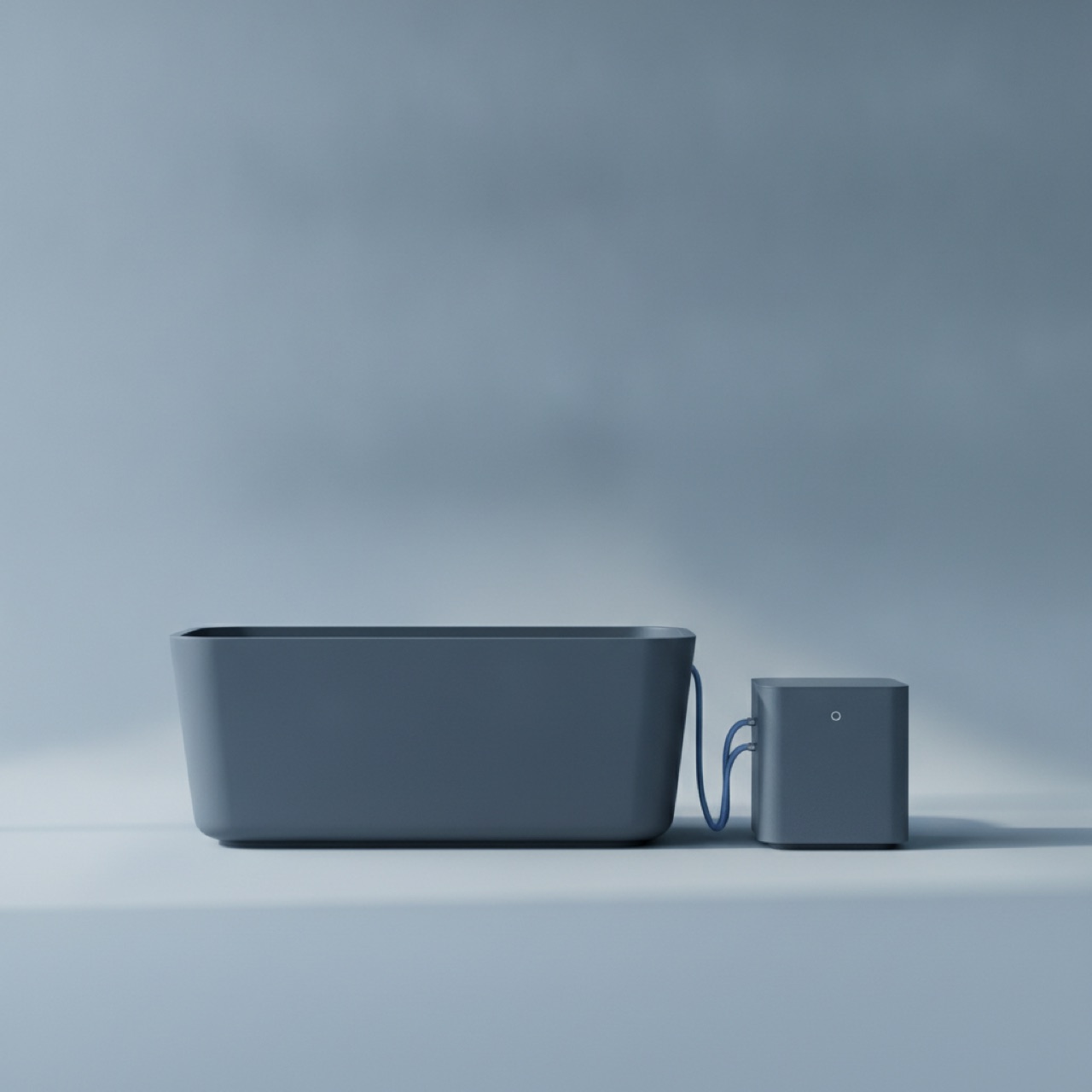
142 days in real cold
Every unit ran in a controlled 8°C ambient room and an unheated garage in Trondheim. We logged temperature stability, recovery rate, noise, and energy draw on calibrated probes.